When you are purchasing a Smart Lock, a hotel operator, distributor or system integrator may receive two very different smart lock proposals.
One comes from a Chinese OEM manufacturer offering flexible customization, a competitive hardware price and faster sampling. The other comes from an international brand with stronger market recognition, established approval channels and local service support.
The two quotations may appear to cover similar products, but they often represent different sourcing models. For B2B buyers, the real question is not which country makes better smart locks. It is which supplier model fits the project, target market and long-term operating plan. In this article, iLockey will draw on its more than 10 years of customer service experience to provide you with some inspiration.

1. What Are You Actually Comparing?
In fact, the difference is not simply where the lock is manufactured.
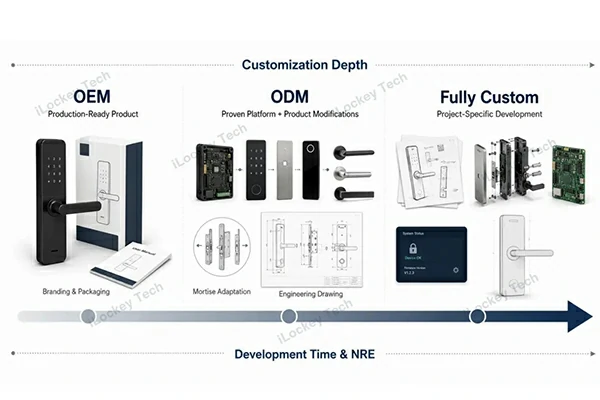
1) Chinese OEM/ODM smart lock manufacturers
Chinese manufacturers usually compete through production flexibility, supply-chain efficiency and customization capability. They are often suitable for buyers who need:
- private labeling
- flexible MOQ
- custom finishes or packaging
- mortise and door adaptation
- firmware or access-method adjustments
- software-platform selection
- faster engineering response
This model is commonly used by distributors, private-label brands, project contractors and system integrators.
2) International brands and solution providers
International brands usually compete through established market recognition, standardized product systems and regional support structures. They may be suitable when buyers need:
- an approved or specified brand
- established local distribution
- familiar project documentation
- regional installation or maintenance support
- a standardized global product system
These suppliers are not only selling hardware. Their pricing may also reflect brand value, channel structure, local service and project acceptance.

2. How to Compare Two Smart Lock Quotations Fairly?
Two quotations should only be compared after their scope has been aligned. We list a quick table.
| Comparison Area | What the Buyer Should Confirm |
| Hardware | Housing material, finish, mortise, door thickness and accessories |
| Access methods | Card, PIN, fingerprint, Bluetooth, app or remote access |
| Software | Included platform, user limits and recurring fees |
| Connectivity | Gateway requirements, network type and remote-management conditions |
| Integration | API, SDK, PMS or third-party system support |
| Compliance | Documents for the exact model and intended market |
| Customization | Logo, packaging, firmware, finish and tooling charges |
| Delivery | Sample, first-order and repeat-order lead times |
| After-sales | Warranty, spare parts, replacements and technical support |
| Commercial terms | MOQ, Incoterms and non-recurring charges |
A USD 60 lock and a USD 200 lock may not include the same software, certification, accessories or service commitments. Buyers should therefore request a complete commercial and technical scope rather than compare only the unit price.

3. Which Supplier Model Fits Different Buyers?
Based on iLockey‘s more than 10 years of experience in the smart lock industry, we have a deep understanding of which supplier model is more suitable for different types of buyers. Below, we have listed the factors that different buyers should consider when making a purchase.
1) Distributors and private-label brands
These buyers usually prioritize margin, branding control, product differentiation and flexible order quantities.
A qualified Chinese OEM/ODM manufacturer is often suitable when the buyer wants to develop its own brand rather than resell an established international brand.
2) Hotels and apartment operators
Operators should prioritize:
- door compatibility
- guest or tenant workflows
- staff permissions
- emergency access
- management software
- maintenance efficiency
Both supplier models may work. The decision should depend on operational requirements rather than brand name alone.
3) Property developers and contractors
These buyers often need:
- specification approval
- fire-door and hardware coordination
- installation documentation
- delivery scheduling
- project handover support
- long-term spare parts
An approved international brand may reduce specification resistance, while an experienced OEM manufacturer may provide greater project adaptation and cost control.
4) System integrators
System integrators usually prioritize:
- API or SDK availability
- technical documentation
- software flexibility
- data control
- firmware support
- integration testing
Chinese OEM/ODM manufacturers may be more suitable when the project requires hardware and software adaptation.
4. How to Qualify a Chinese Smart Lock Manufacturer?
Not all manufacturers provide the same engineering, quality or project capability. You should evaluate six areas.
1) Production capability
Confirm whether the supplier has real production, assembly, testing and quality-control processes.
2) Engineering understanding
A professional supplier should ask about:
- door material
- door thickness
- mortise
- opening direction
- project quantity
- access methods
- network conditions
- software requirements
A supplier that recommends a lock without understanding the door or system may create installation problems later.
3) Model-specific documentation
Reports and certificates should correspond to the product being quoted, not simply another model in the supplier’s catalogue.
4) Sample-to-production control
The supplier should define:
- the approved sample
- accepted finish and color
- component specifications
- firmware version
- inspection criteria
- change-approval procedures
5) Software responsibility
The buyer should know which company owns and maintains the software platform, what services are included and which functions require additional development.
6) After-sales structure
The supplier should explain whether overseas problems are handled through:
- replacement units
- spare parts
- remote troubleshooting
- local partners
- return-to-factory repair
5. When an International Brand May Be the Better Choice
An international brand may be more suitable when:
- the project specifies an approved brand
- the consultant does not accept alternative suppliers
- local installation and service are mandatory
- the owner already uses the same global system
- brand recognition supports property sales or positioning
- the buyer wants to minimize internal product qualification
In these cases, the higher purchase price may be justified by easier approval and local execution.
6. When a Chinese OEM/ODM Manufacturer May Be the Better Choice
According to our customers’ feedback, a Chinese manufacturer may offer more value when:
- the buyer wants to build its own brand
- purchase cost and channel margin are important
- the product needs custom appearance or packaging
- the door or mortise requires adaptation
- the project needs flexible sampling
- API, SDK or system integration is required
- the buyer needs multiple smart lock categories from one supplier
- faster product development is commercially important
The main advantage is not simply a lower price. It is greater control over product definition, branding and project adaptation.
7. Should You Use More Than One Supplier?
A secondary supplier can improve supply-chain resilience, but smart locks are not always interchangeable. Before approving a second source, you should check:
- door-preparation compatibility
- mortise dimensions
- software architecture
- gateway requirements
- credential compatibility
- certification scope
- spare-parts differences
Rather than applying a fixed purchasing ratio, buyers can qualify an alternative model or supplier in advance and activate it when required.
8. Final Buyer Checklist
Before selecting a smart lock supplier, we advise you ask:
- Does the product fit the actual door and mortise?
- Which documents are mandatory for the target market?
- Do those documents cover the quoted model?
- Which software, gateway and service fees apply?
- Is API, SDK or PMS integration required?
- How will the approved sample be controlled during production?
- What is the realistic lead time for repeat orders?
- Which spare parts should be stocked locally?
- Who handles hardware, software and installation problems?
- Can the supplier support future phases of the project?
9. Smart Lock Procurement FAQs
iLockey has compiled some frequently asked questions from our customers along with their answers for your reference.
1) Are Chinese smart lock manufacturers always cheaper?
They often offer lower ex-factory hardware prices, but the final project cost also depends on software, gateways, integration, logistics, spare parts and support.
2) Are international brands always safer for commercial projects?
Not necessarily. They may reduce approval or local-service risks, but the product still needs to match the actual door, software and operational requirements.
3) What is the biggest mistake when comparing suppliers?
Comparing unit prices without confirming whether the quotations include the same hardware, software, certification, accessories and after-sales scope.
4) Should buyers request an API or SDK from every supplier?
Only when the project requires third-party software integration. Buyers should also confirm documentation quality, commercial conditions and technical support responsibilities.
5) How can buyers reduce mass-production risk?
Approve a representative sample, document the configuration, complete a small pilot and define change-control and inspection requirements before volume production.
6) Should buyers always use two smart lock suppliers?
No. A second source is useful only when the products can satisfy the same door, software and compliance requirements. In some projects, maintaining an approved backup model is more practical than splitting every order.
10. Conclusion
Choosing between a Chinese smart lock manufacturer and an international brand is not simply a decision between lower price and stronger branding. It is a decision that involves product control, project acceptance, software architecture, supply flexibility, after-sales responsibility, and long-term operating cost. International brands may be more suitable for projects that require an approved name, established regional support, or a standardized global system.
A qualified Chinese OEM/ODM manufacturer, on the other hand, may offer more value when buyers need private labeling, flexible customization, engineering response, and closer control over the product and supply chain. The safest approach is to define the technical and commercial scope, test representative samples, and complete a pilot installation before moving to volume deployment.
With core team members bringing over 20 years of experience in the smart lock industry, iLockey supports OEM, ODM, and project-based smart lock solutions for distributors, hotels, apartments, property projects, and system integrators. To receive a suitable recommendation, buyers can provide door and mortise specifications, application type, project quantity, required access methods, software and integration requirements, as well as target market and compliance needs.