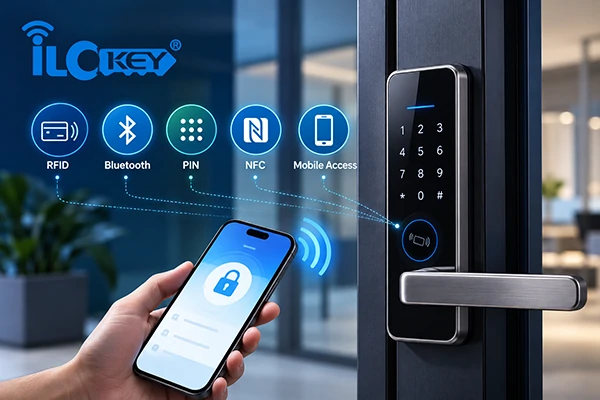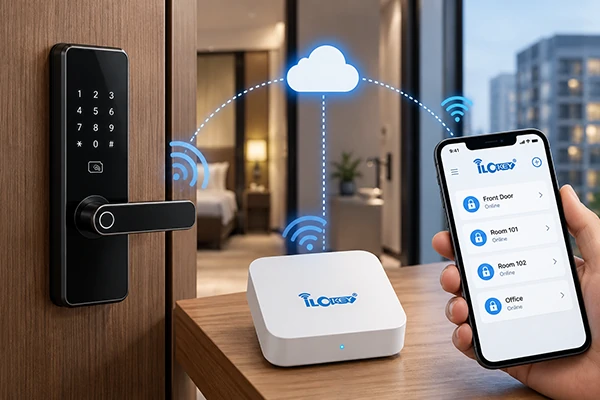
For distributors, hotel operators, property developers, system integrators, and smart home brands, a smart lock project often involves hardware, software, mobile applications, cloud platforms, installation support, certifications, and long-term after-sales service. Before choosing a supplier, you need to understand the application scenario, door compatibility, system structure, software platform, certification requirements, and supplier capabilities.
iLockey is a B2B smart lock and hotel lock manufacturer based in Shenzhen, China. With over 15 years of experience in smart lock and hotel lock manufacturing, iLockey supports distributors, hotel solution providers, project contractors, smart home brands, and OEM/ODM customers with smart lock and access control solutions.
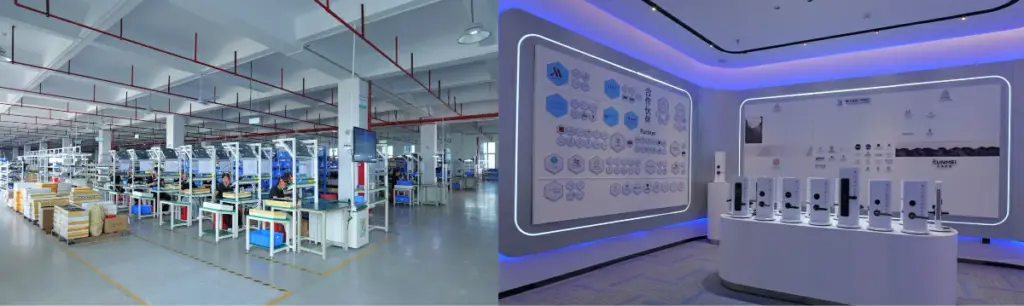
Our production base covers approximately 15,000 m², with an annual production capacity of around 600,000 pieces. iLockey products and solutions have been supplied to customers in more than 60 countries.
This guide is designed to help global buyers understand how smart lock sourcing works and how to reduce procurement risks when selecting a manufacturing partner based on our 10+ years of experience.
1. What Is Smart Lock Sourcing?
Smart lock sourcing refers to the process of selecting, evaluating, and purchasing smart lock products or complete access control solutions from professional manufacturers or OEM/ODM suppliers. Depending on the business model and project requirements, you may source:
- Finished smart lock products
- OEM smart locks with their own brand
- ODM smart lock solutions based on mature designs
- White-label smart locks and applications
- Hotel lock systems
- Apartment and rental property lock systems
- Cabinet, locker, and access control solutions
- Complete access management solutions for project use
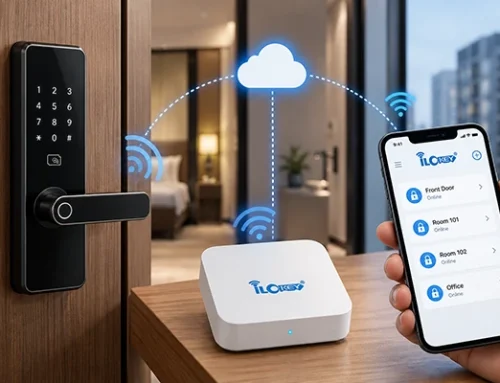
Unlike mechanical locks, smart locks usually require both physical hardware and software support. A complete smart lock solution may include the lock body, PCB board, motor, firmware, mobile app, cloud platform, gateway, RFID card encoder, hotel lock software, access control device, elevator control system, energy-saving switch, DND system, or PMS integration.
In many projects, the key challenge is not only whether the lock can open and close smoothly, but whether the entire system can work reliably in the real operating environment.
2.Why Smart Lock Sourcing Is Different from Mechanical Lock Purchasing
Mechanical lock purchasing is mainly focused on material, structure, finish, key system, and installation dimensions. Smart lock sourcing is more complex because the product is part of a connected system.
iLockey recommends considering the following factors when purchasing a smart lock.
- Door type and lock body compatibility
- Door thickness and backset
- Mortise or lock body standard
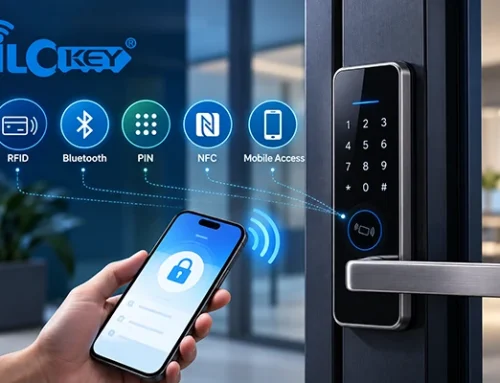
- Unlocking methods
- Communication protocol
- Battery life and emergency power design
- Mobile app or management platform
- Gateway or cloud connection
- Access logs and user permissions
- API or PMS integration
- Certification requirements
- Firmware updates and technical support
- Installation and after-sales service
For residential locks, user experience and app stability are important. For hotel locks, card management, staff permissions, audit trail, PMS integration, elevator control, and offline reliability are critical. For apartment projects, remote access management and temporary password distribution may be the core value. For commercial projects, access control integration and user management become more important.
Therefore, successful smart lock sourcing starts from one question: Where will the lock be used? Once the application scenario is clear, the right product type, software platform, certification requirement, and supplier capability become much easier to define.
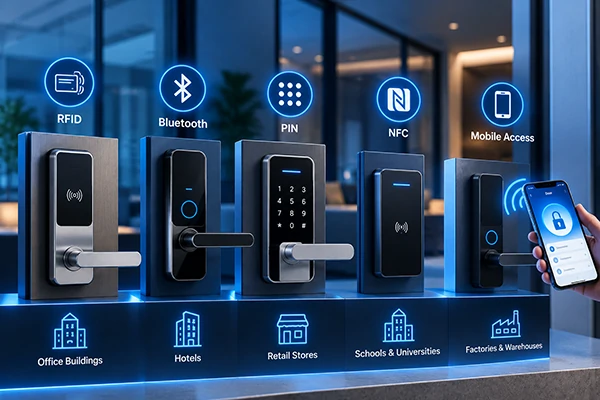
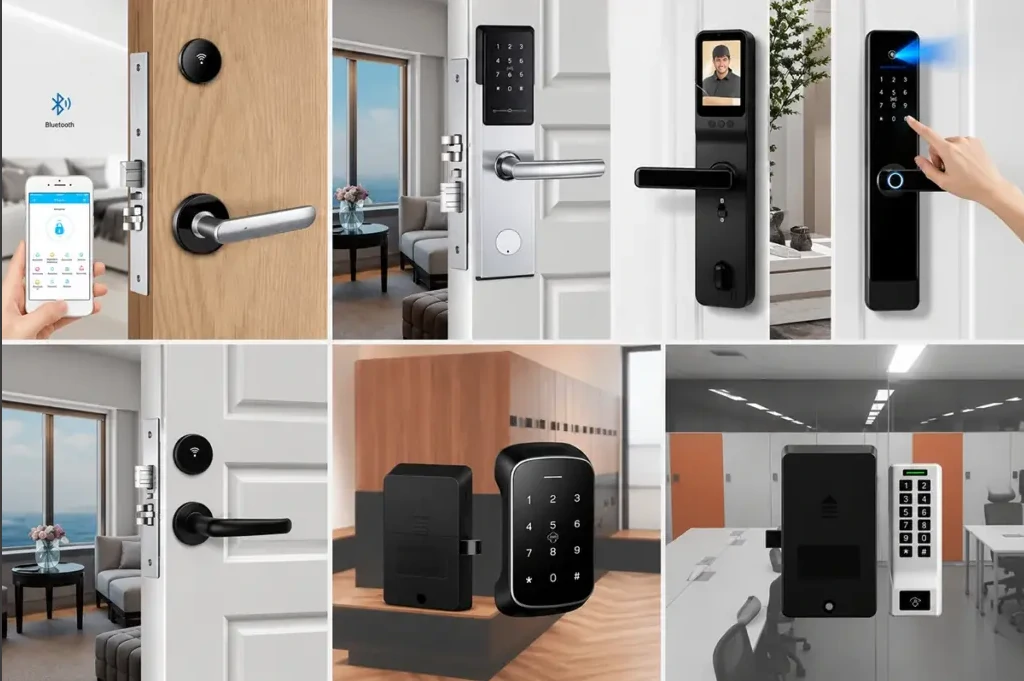
3. Common Types of Smart Locks by Application Scenario
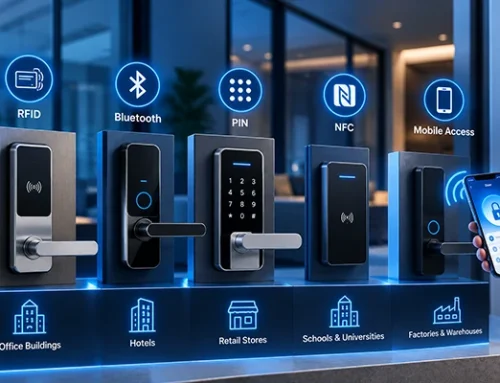
Based on our industry experience,smart locks can be classified by unlocking method, such as fingerprint, keypad, RFID card, mobile app, face recognition, or mechanical key. They can also be classified by communication protocol, such as Bluetooth, Wi-Fi, Zigbee, Z-Wave, or Matter-related solutions.
However, for real procurement projects, classification by application scenario is usually more useful. A lock for a private home, a hotel room, a student residence, a serviced apartment, an office, or a cabinet may require completely different hardware structures, software platforms, certifications, and service support.
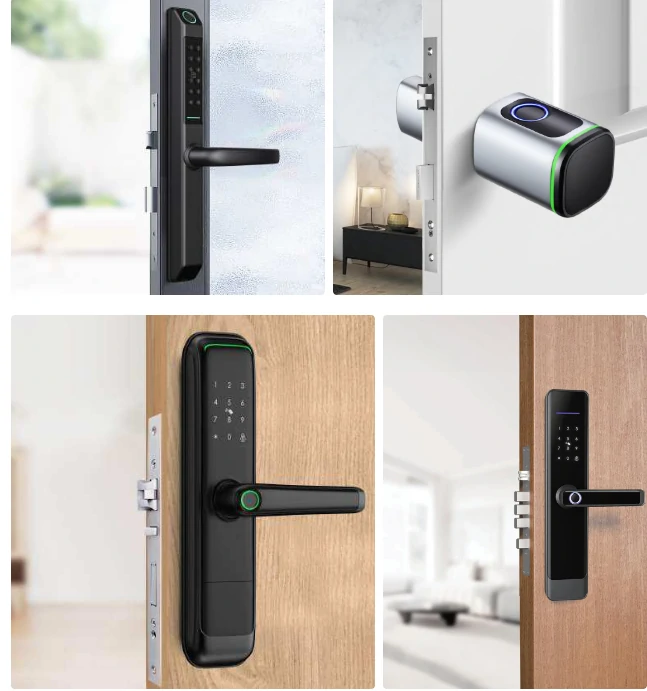
1) Residential Smart Locks
Residential smart locks are used for houses, villas, apartments, condominiums, and private homes. Buyers usually focus on appearance, easy installation, convenient unlocking, battery life, app experience, and smart home compatibility. Common unlocking methods include:
- Fingerprint
- PIN code
- RFID card
- Bluetooth app
- Wi-Fi remote control
- Face recognition, depending on model
- Mechanical key
- Emergency power supply
Common residential products include fingerprint smart locks, keypad smart locks, smart deadbolts, Wi-Fi smart locks, Bluetooth smart locks, Tuya smart locks, and TTLock smart locks.
For residential markets, local user habits are very important. For example, based on our experience,north American buyers may prefer deadbolts or ANSI mortise locks, while European, Middle Eastern, and Asian markets may require different mortise structures, lock bodies, cylinders, and door thickness compatibility.
2) Hotel Smart Locks
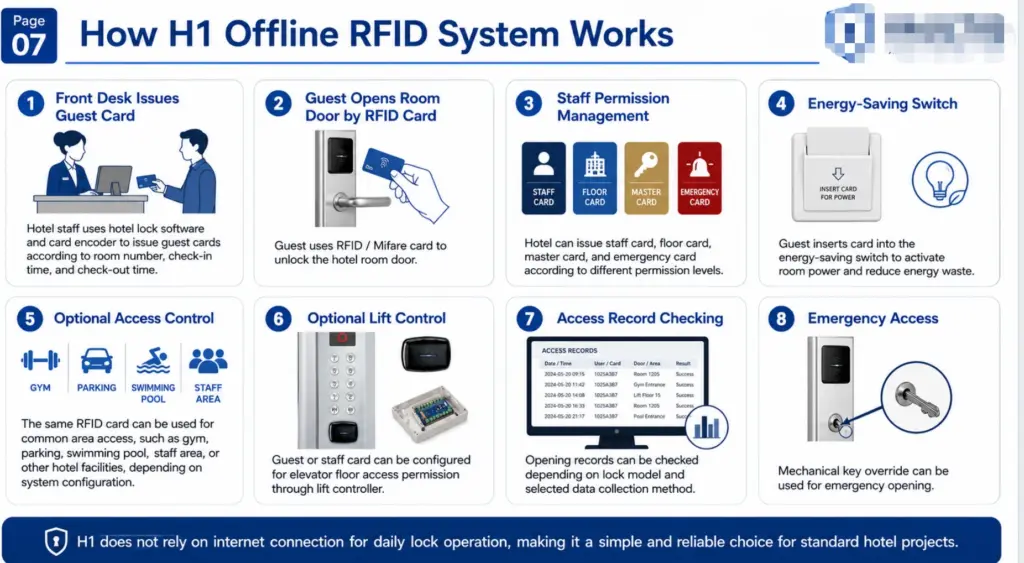
Hotel smart locks are not standalone consumer products. They are part of a complete hotel access management system.A hotel lock project may require:
- RFID card management
- Guest check-in and check-out
- Staff access control
- Audit trail records
- Room status management
- Card encoder
- Handheld programmer
- Elevator control
- Energy-saving switch
- DND system
- Door access control
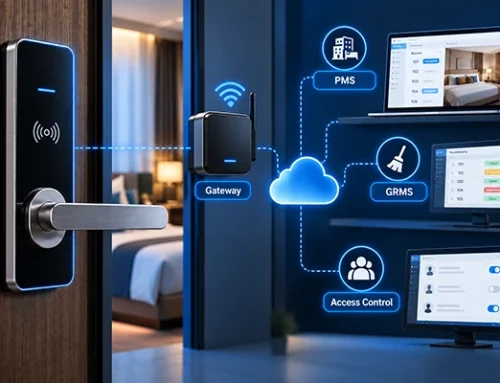
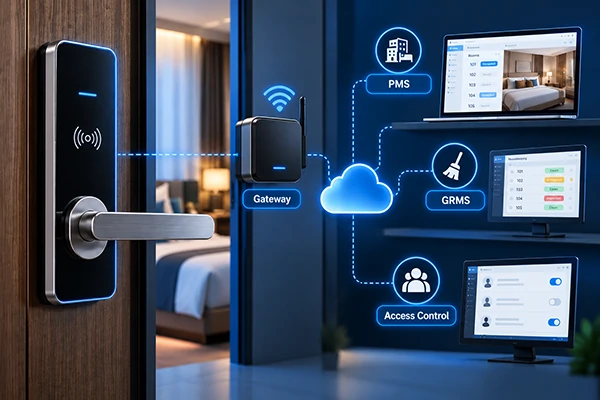
- PMS integration
For hotel projects, the management software is often as important as the lock hardware. If the software is difficult to use or cannot integrate with the hotel’s existing management workflow, the project may face operational problems after installation.
iLockey provides RFID hotel locks, Bluetooth hotel locks, hotel lock management software, elevator control systems, energy-saving switches, DND systems, and PMS integration support for applicable hotel projects.
For PMS-related projects, iLockey can evaluate integration requirements with systems such as Opera, Fidelio, or other hotel management platforms, depending on the specific project scope and technical requirements.
3) Apartment and Rental Property Smart Locks
Apartment smart locks are widely used in serviced apartments, student housing, rental units, co-living spaces, and multi-family buildings. The main requirement is usually centralized access management. Property managers may need to:
- Create temporary passwords
- Manage tenant access remotely
- View access records
- Control multiple locks in one platform
- Manage different rooms, buildings, or properties
- Reduce physical key handover
- Support self check-in
- Use mobile app or cloud-based management
iLockey recommend that for apartment and rental property projects, the supplier’s cloud platform, gateway solution, account structure, and permission management should be carefully evaluated before bulk purchasing.
Functions such as remote unlocking, temporary PIN codes, gateway connection, and access logs may vary depending on the lock model, software platform, and gateway configuration.
4) Commercial Smart Locks and Access Control
Commercial smart locks are used in offices, schools, hospitals, retail stores, co-working spaces, warehouses, and enterprise facilities.These projects may require more advanced access management functions, such as:
- Multi-level user permissions
- Department access control
- Visitor management
- Attendance records
- Public area access control
- Integration with existing security systems
- Electric strike, magnetic lock, or controller compatibility
- Web-based management platform
In commercial projects, you should not evaluate only one lock model. It is more practical to evaluate whether the supplier can provide a suitable access control solution for the entire application.
5) Cabinet and Locker Smart Locks
Cabinet locks and locker locks are used in gyms, schools, offices, smart lockers, retail stores, parcel lockers, staff areas, and asset management systems.
Compared with standard door locks, locker locks are usually smaller, more frequently used, and more customized according to the application environment.
Typical products include:
- Smart cabinet locks
- Electronic locker locks
- RFID locker locks
- Bluetooth cabinet locks
- Parcel locker locks
- Gym locker locks
- Asset management locks
These projects may require special installation structures, compact design, low power consumption, centralized management, or customized access methods.
4. Understanding Smart Lock System Architecture
When you first evaluate smart locks, they often focus on appearance, unlocking methods, or price. However, for project-based sourcing, it is important to understand the complete system behind the lock.
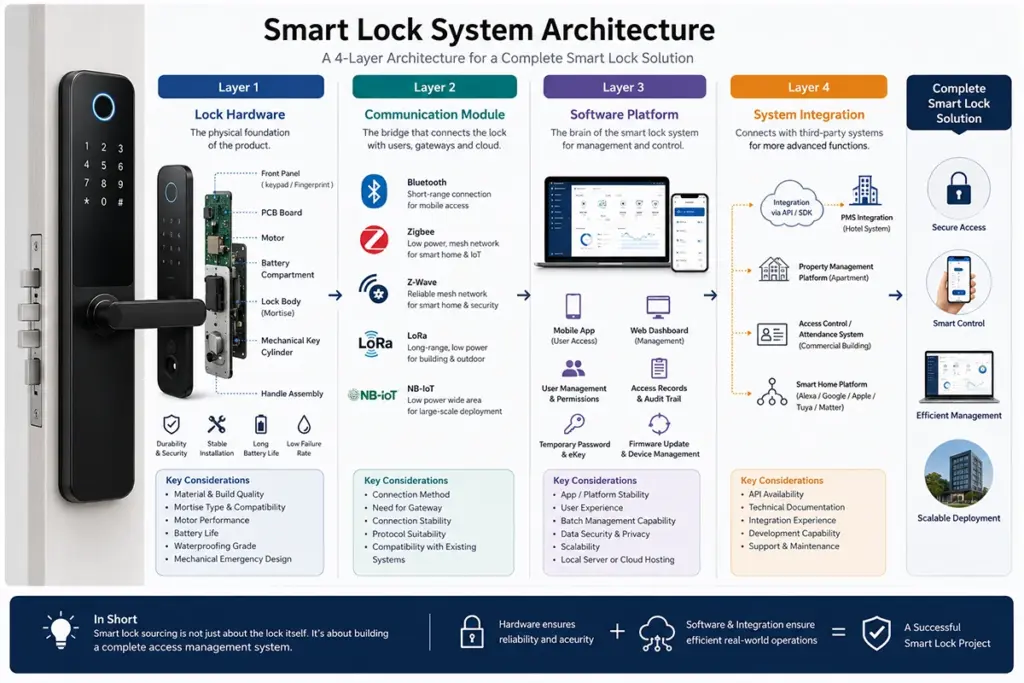
Based on iLockey’s over 10 years of experience in the smart lock manufacturing industry,a modern smart lock system can generally be divided into four layers.Let us now analyze each layer in turn.
1) Layer 1: Lock Hardware
This is the physical foundation of the product. It includes:
- Front and back panels
- Lock body or mortise
- Handle structure
- Motor
- PCB board
- Sensors
- Battery compartment
- Emergency power interface
- Mechanical key cylinder
- Installation accessories
Hardware quality affects durability, installation stability, security, and failure rate. Buyers should check material, surface finish, mortise type, motor performance, battery life, waterproof level, emergency opening method, and door compatibility.
2) Layer 2: Communication Module
The communication module determines how the lock connects with users, mobile phones, gateways, or cloud platforms.
Common communication technologies include:
- Bluetooth
- Wi-Fi
- Zigbee
- Z-Wave
- LoRa
- NB-IoT
- Matter-related solutions
Different protocols suit different applications. Bluetooth is commonly used for local mobile app control. Wi-Fi can support direct remote access but may consume more power. Zigbee and Z-Wave are often used in smart home or gateway-based systems. For hotels, apartments, and commercial projects, the communication structure should be evaluated together with the management platform.
Before choosing a lock, buyers should confirm:
- Does the lock require a gateway?
- Can it support remote access?
- How stable is the connection?
- Is the protocol suitable for the target market?
- Does the software platform support the required functions?
Matter-related smart lock requirements should be confirmed carefully according to the actual product model, certification status, and project requirements.
3) Layer 3: Software Platform
Software is where many smart lock projects succeed or fail.
A smart lock software platform may include:
- Mobile app
- Web dashboard
- Cloud server
- User management
- Temporary password function
- Access logs
- Device management
- Firmware upgrade
- API support
- Hotel lock management software
- PMS or third-party integration
For residential locks, the app experience is important. For hotels, apartments, and commercial projects, management software is even more critical. If the platform cannot support batch management, staff permissions, access logs, or integration requirements, the lock may not be suitable for a professional project.
iLockey can support different software ecosystems depending on project requirements, including Tuya smart lock solutions, TTLock smart lock solutions, TThotel Bluetooth hotel lock system, RFID hotel lock software, and PMS integration evaluation for applicable hotel projects.
4) Layer 4: System Integration
System integration is especially important for hotels, apartments, commercial buildings, and smart home brands.
Examples include:
- PMS integration for hotels
- API integration for property management systems
- Elevator control integration
- Access control system integration
- Smart home integration depending on platform
- Customized software or white-label app requirements
- DND system and hotel room control accessories
If your project requires integration, you should confirm the supplier’s technical capability before ordering samples, not after mass production.
5.Where Can You Source Smart Locks?
China is one of the most important global manufacturing hubs for smart locks and access control products. Major production areas include Shenzhen, Dongguan, Zhongshan, Yongkang, and other hardware and electronics supply chain regions.
China’s advantages include:
- Mature electronics supply chain
- Strong lock body and hardware manufacturing capability
- Competitive cost-performance
- Flexible OEM/ODM customization
- Fast product development
- Wide product variety
- Strong production capacity
Other smart lock manufacturing regions may include South Korea, Japan, Europe, the United States, Vietnam, and India. However, many global brands, distributors, and project contractors still rely on Chinese manufacturing ecosystems for OEM/ODM smart lock production.
When sourcing from China, buyers should understand that not all suppliers have the same capabilities. Some suppliers are trading companies. Some focus mainly on hardware assembly. Some rely completely on third-party software platforms. Some have stronger OEM/ODM, engineering, certification, and project support capabilities.For example iLockey.
The goal is not simply to find the cheapest supplier. The goal is to find a supplier whose product range, software capability, manufacturing quality, and service level match the project.
6. Smart Lock Supplier Types
As a company with over a decade of experience in the smart lock industry, we can tell you when searching for smart lock suppliers, you may encounter different types of companies.
1) Trading Companies
Trading companies usually offer a wide range of models from different factories. They may be flexible for small orders, but technical support, customization, and long-term product consistency may be limited.
2) Hardware Assembly Factories
Some suppliers focus mainly on assembly. They may have competitive pricing, but they may rely on external partners for software, firmware, app platforms, and cloud services.
3) Software-Platform-Based Suppliers
Some suppliers are strong in software platforms but may not manufacture the lock hardware themselves. They may be suitable for software-driven projects but require careful evaluation of hardware quality and supply stability.
4) OEM/ODM Smart Lock Manufacturers
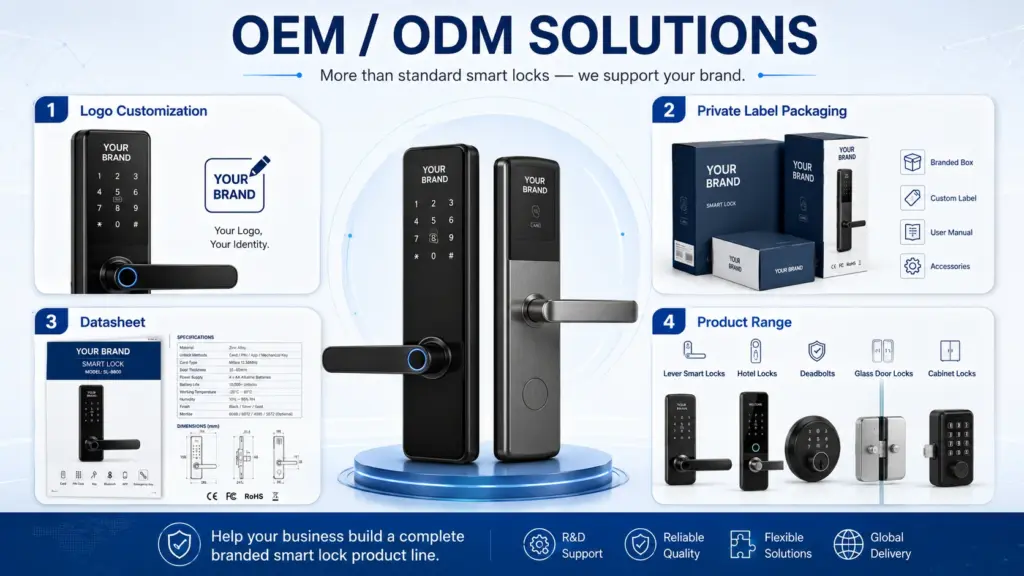
A professional OEM/ODM smart lock manufacturer should be able to support product selection, structure evaluation, branding, packaging, software platform matching, testing, quality control, and after-sales support.
Such as iLockey focuses on B2B OEM/ODM smart lock and hotel lock projects. Our product range covers hotel locks, residential smart locks, apartment locks, cabinet locks, access control systems, elevator control, energy-saving switches, DND systems, and hotel system accessories.
7. Smart Lock Sourcing Cost Structure
A lower unit price does not always mean a lower total project cost.When choosing a smart lock, cost is likely the first thing you consider. Drawing on over a decade of industry experience, iLockey outlines the cost structure of smart locks and the factors that influence it.
A typical smart lock sourcing cost may include:
- Product cost
- Lock body or mortise cost
- Software platform cost
- App customization cost
- Cloud service or licensing cost
- Tooling cost for customized parts
- Logo and packaging customization cost
- Certification cost
- Sample and pilot testing cost
- Shipping cost
- Installation and after-sales cost
Key factors affecting price include:
- Material and surface finish
- Unlocking methods
- Communication protocol
- Waterproof or fire-rated requirements
- Mortise type
- Battery and motor configuration
- App or cloud platform
- PMS/API integration
- Certification requirements
- Order quantity
- OEM/ODM customization level
The cost-performance of electronics, hardware, die-casting, surface treatment, PCB, packaging and assembly supply chains in China are usually very good. But please don’t always select the supplier with the cheapest quote.
With professional projects, the costs should also cover software reliability, installation success rate, availability of spares, technical support, and long term maintenance.
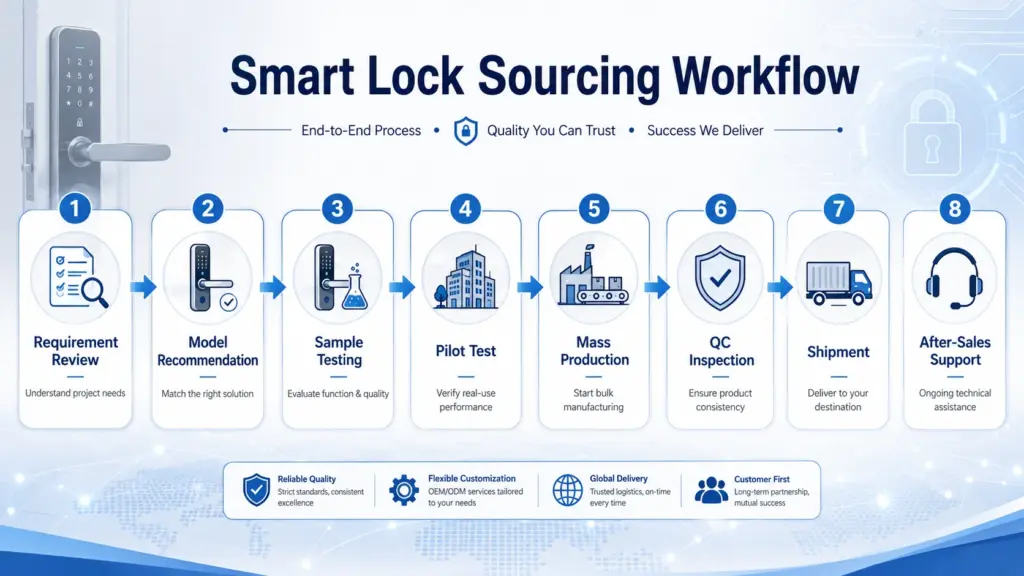
8. How to Source Smart Locks Step by Step?
If you are new to purchasing, iLockey will guide you step-by-step through the process of buying smart locks.
1) Step 1: Define Your Application Scenario
The first step is to clearly define where the lock will be used. Common scenarios include:
- Residential homes
- Hotels
- Serviced apartments
- Student housing
- Commercial buildings
- Offices
- Cabinets and lockers
- Smart locker systems
Different scenarios require different products, certifications, software platforms, and support capabilities.
2) Step 2: Define Your Technical Requirements
After confirming the application scenario, prepare the basic technical requirements.Important information includes:
- Door type
- Door thickness
- Lock body or mortise type
- Backset size
- Opening direction
- Required unlocking methods
- Communication protocol
- App or management platform requirement
- Remote control requirement
- PMS/API integration requirement
- Certification requirement
- Target market
- Quantity
- OEM/ODM branding requirement
The clearer the requirements are, the easier it is for the supplier to recommend the right model.
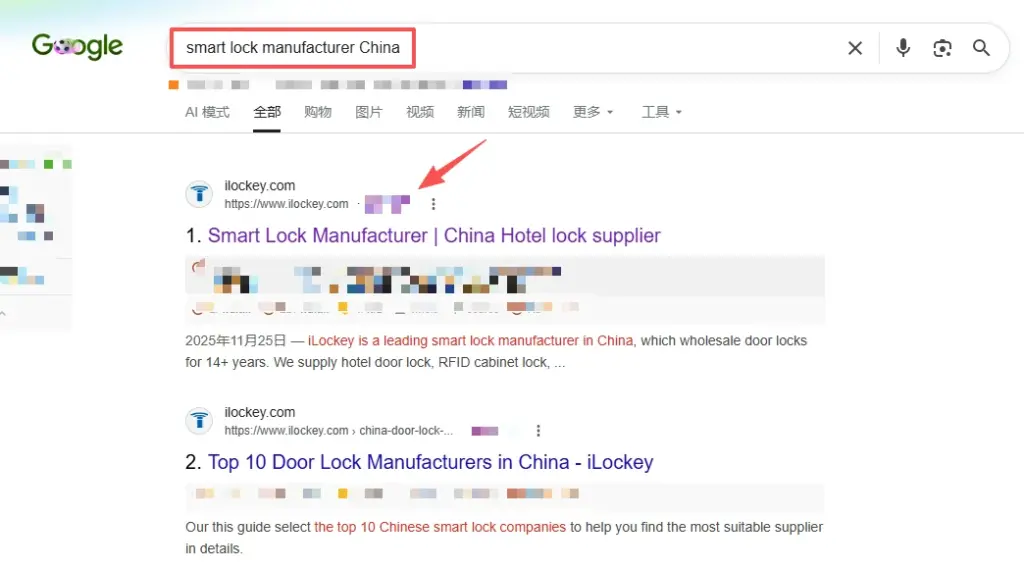
3) Step 3: Find Potential Suppliers
You can find smart lock suppliers through:
- Google search
- Industry exhibitions
- Alibaba or other B2B platforms
- Industry referrals
- Trade associations
- Existing hardware or access control networks
At this stage, the goal is not to immediately choose one supplier. The goal is to build a shortlist of suppliers who appear to match the project requirements.
4) Step 4: Request Product Information and Quotations
When contacting suppliers, do not only ask for price. iLockey suggest you should also request:
- Product catalog
- Technical datasheets
- Installation drawings
- Certification documents
- Software platform information
- App screenshots or demo account
- Warranty terms
- Lead time
- MOQ
- Packaging information
- OEM/ODM options
- Previous project experience
A professional supplier should be able to guide buyers through model selection instead of only sending a long catalog.
5) Step 5: Confirm Project Details Before Ordering
Before placing an order, confirm all important details in writing. These may include:
- Product model and version
- Mortise or lock body
- Door thickness range
- Finish color
- Unlocking methods
- Software platform
- Gateway requirement
- Logo and packaging
- Certification responsibility
- Payment terms
- Delivery terms
- Warranty terms
- Spare parts
- Technical support scope
Many sourcing problems happen not because the product is bad, but because expectations were not clearly defined before the order.
6) Step 6: Order Samples
Sample testing is essential for smart lock sourcing.A sample order allows you to check:
- Build quality
- Surface finish
- Installation process
- Lock body compatibility
- Unlocking speed
- App operation
- Card or password management
- Communication stability
- Battery performance
- User experience
For smart locks, sample testing is often more valuable than only reviewing photos and specifications.
7) Step 7: Conduct Pilot Testing
For hotels, apartments, commercial buildings, and access control projects, pilot testing is strongly recommended.A pilot test helps verify:
- Real installation compatibility
- Signal stability
- User management process
- Software reliability
- Staff operation process
- Guest or tenant experience
- Integration performance
- Maintenance requirements
Installing a small number of locks in a real environment can significantly reduce risk before mass deployment.
8) Step 8: Proceed with Mass Production
After sample and pilot testing are approved, you can proceed with mass production. Before production starts, both parties should confirm:
- Final product specification
- Approved sample standard
- Logo and packaging design
- Software configuration
- Inspection standard
- Delivery schedule
- Shipping documents
- After-sales support arrangement
A reliable supplier should have clear quality control processes before shipment.
9. Smart Lock Supplier Evaluation Checklist
Choosing the right smart lock supplier is not only about comparing prices. We advise a supplier should be evaluated from multiple angles.
1) Project Experience
Check whether the supplier has experience with similar projects.
For example, a supplier focused only on home locks may not be suitable for hotel PMS integration projects. A supplier focused only on simple Bluetooth locks may not be able to support apartment cloud management or commercial access control.
iLockey has experience in hotel lock, residential smart lock, apartment lock, cabinet lock, access control, and OEM/ODM smart lock projects for international customers.
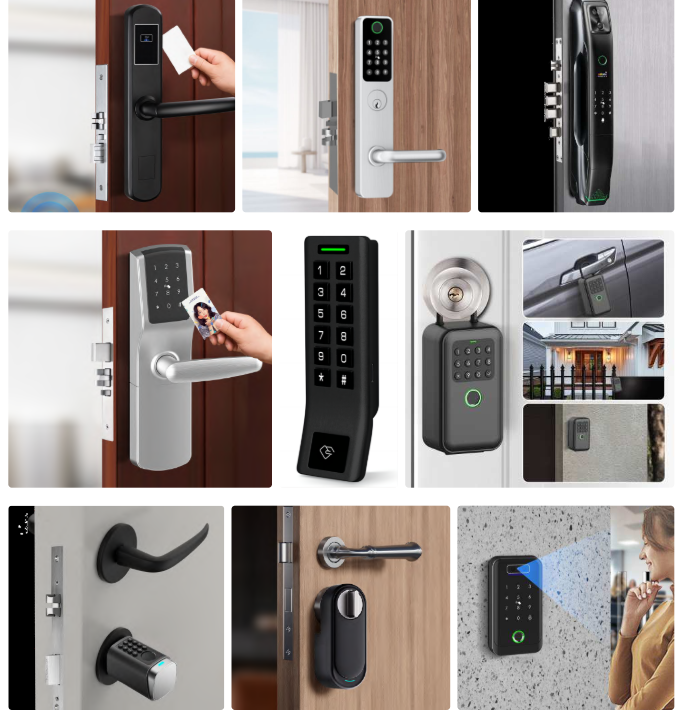
2) Product Range
A wider product range helps buyers match different market needs.
iLockey’s product range includes:
- RFID hotel locks
- Bluetooth hotel locks
- Tuya smart locks
- TTLock smart locks
- Residential smart locks
- Apartment smart locks
- Smart deadbolts
- Cabinet and locker locks
- Access control devices
- Elevator control systems
- Energy-saving switches
- DND systems
- Hotel system accessories
3) Software Capability
Software capability is critical for smart lock projects.We support should check whether the supplier can support:
- Mobile app
- Cloud platform
- Web management
- Temporary password
- Access records
- Gateway connection
- Hotel lock management software
- PMS integration
- API support depending on project and platform
- Firmware updates
iLockey supports different software ecosystems depending on project requirements, including Tuya, TTLock, TThotel Bluetooth hotel lock system, RFID hotel lock software, and PMS integration evaluation for applicable hotel projects.
Functions may vary by product model, gateway, software platform, and project requirements. Buyers should confirm required functions before ordering samples.
4) Certification Support
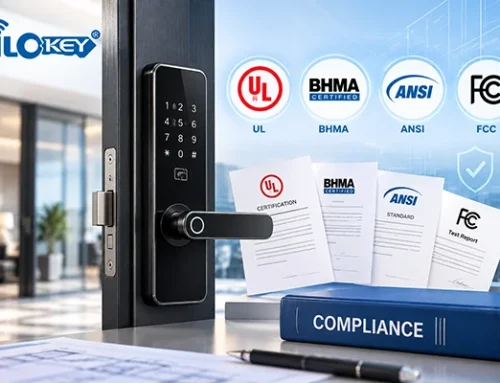
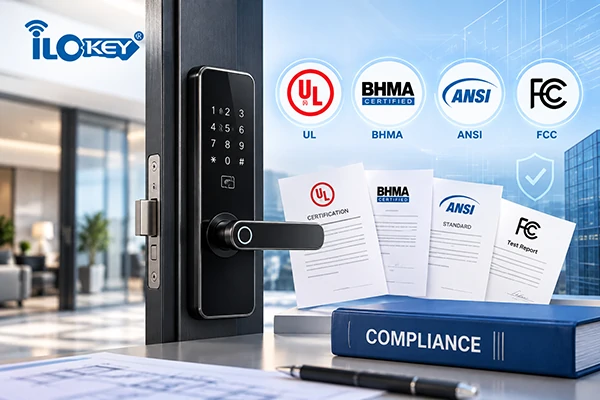
Certification requirements depend on the target market and product model.Common certifications may include:
- CE
- FCC
- RoHS
- UL
- BHMA
- EN1634-1
- EN14846
- IP-rated reports
- Fire-rated test reports
You should always confirm whether the certificate applies to the exact product model they plan to purchase.
iLockey can provide CE, FCC, and RoHS documentation for smart lock products. For specific project requirements, iLockey also provides selected certified models depending on the target market and application.
Examples include:
| Certification / Report | Applicable Product Range |
| UL / BHMA | Selected models such as E912 and K730 |
| EN1634-1 / EN14846 for hotel lock projects | Selected hotel lock models such as E300, E301, C300, E300P, E200, S100, and K710 |
| EN1634-1 / EN14846 for residential smart lock projects | Selected models such as E908, A270, A233, K710, A230, A260, and A240 |
| IP-rated solutions | Selected models such as K710, K733, A210, A213, K5, K7, V2, A216, and AC05 |
Certification availability should always be confirmed according to the exact model, product version, and target market before order confirmation.
5) OEM/ODM Capability
If you are building their own brand or distribution business, OEM/ODM capability is important. Typical OEM/ODM requirements include:
- Logo customization
- Packaging design
- Product color customization
- Function configuration
- Private label cooperation
- Software or app branding
- Product datasheet support
- Installation manual support
- Project-based product recommendation
iLockey supports B2B OEM/ODM cooperation for distributors, brands, hotel solution providers, and project customers.
OEM/ODM customization depends on the product model, order quantity, software platform, and project requirements. For reference, OEM logo customization usually starts from 100 pcs, while private label packaging usually starts from 500 pcs. App customization or software branding should be evaluated and quoted separately. New tooling requirements depend on the actual project scope.
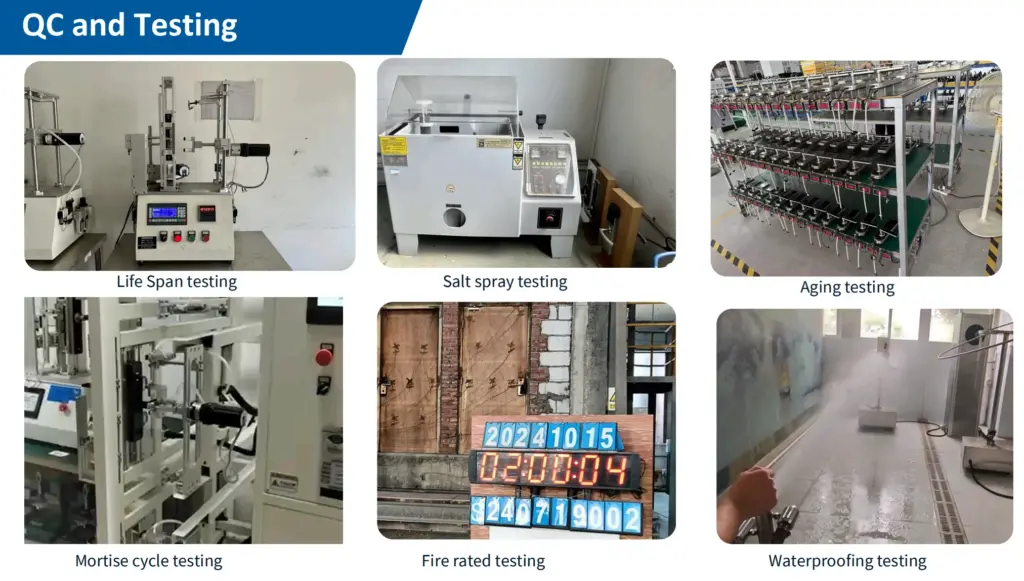
6) Quality Control
A reliable smart lock supplier should have a clear quality control process. Important quality control points include:
- Incoming material inspection
- PCB and electronic component checking
- Function testing
- Motor and handle operation testing
- Card/password/app unlocking test
- Surface finish inspection
- Packaging inspection
- Random inspection before shipment
- Aging test, depending on product and requirement
- Life cycle test, depending on product and requirement
- Salt spray test, depending on finish and requirement
- High and low temperature test, depending on product and requirement
For project customers, sample approval and pilot testing are also important parts of quality control. A clear testing and inspection process can reduce installation risk, return rate, and after-sales pressure after mass deployment.
7) After-Sales Support
Smart locks may require technical support after installation. A good supplier should not disappear after shipment. After-sales support may include:
- Standard warranty service
- Spare parts support
- Installation manual
- Installation video
- Remote technical support
- Software operation guidance
- Distributor training
- Project troubleshooting
- Firmware or platform support depending on project scope
- Large project support process
For hotel, apartment, and commercial projects, after-sales support is often the difference between a long-term partner and a simple product seller.
10. Smart Lock Inquiry Template for Buyers
To receive an accurate quotation and product recommendation, you can prepare the following information before contacting a supplier.
- Application: Hotel / apartment / residential / commercial / cabinet / locker / other
- Target Market: Country or region where the product will be sold or installed
- Door Information: Door type, door thickness, lock body type, backset, opening direction
- Required Unlocking Methods: Fingerprint / PIN code / RFID card / mobile app / mechanical key / face recognition / remote unlocking
- Communication Protocol: Bluetooth / Wi-Fi / Zigbee / Z-Wave / Tuya / TTLock / other
- Software Requirement: Mobile app / web management / cloud platform / hotel system / apartment management / API / PMS integration
- Certification Requirement: CE / FCC / RoHS / UL / BHMA / EN1634-1 / EN14846 / fire rating / IP rating / other
- Order Quantity: Sample quantity, first order quantity, expected annual quantity
- Branding Requirement: Logo / packaging / manual / app customization / private label
- Project Timeline: Sample schedule, pilot test schedule, mass production deadline
The more complete the information is, the faster a supplier can recommend the right solution.
I understand, you may have different requirements depending on their market, application scenario, and business model. Based on real project inquiries, we have listed the most common buyer requirements include the following types.
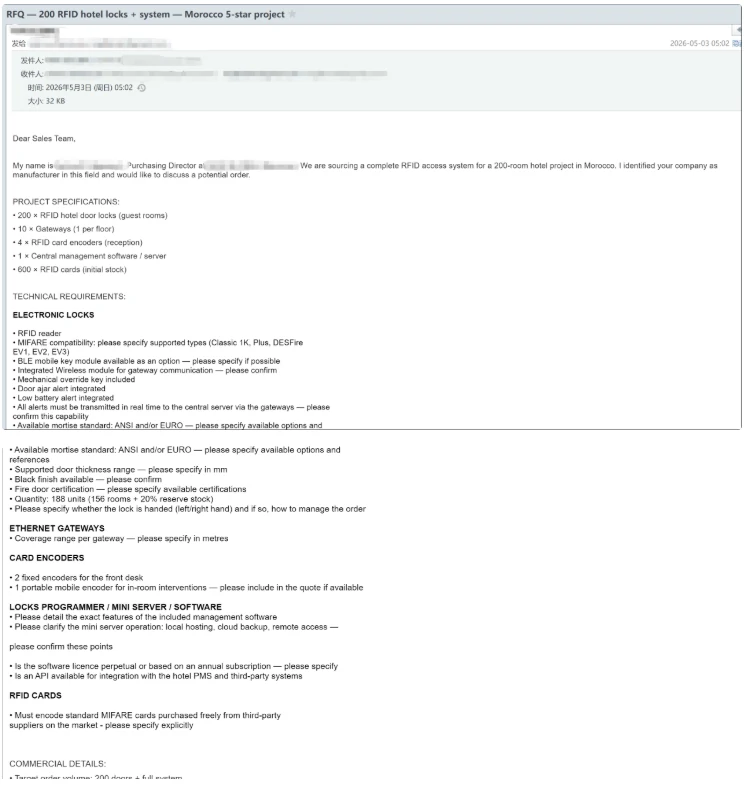
1) Hotel Lock System and PMS Integration Inquiries
Hotel buyers usually ask about RFID hotel locks, card management software, PMS integration, staff access control, audit trail records, elevator control, energy-saving switches, DND systems, and installation support.
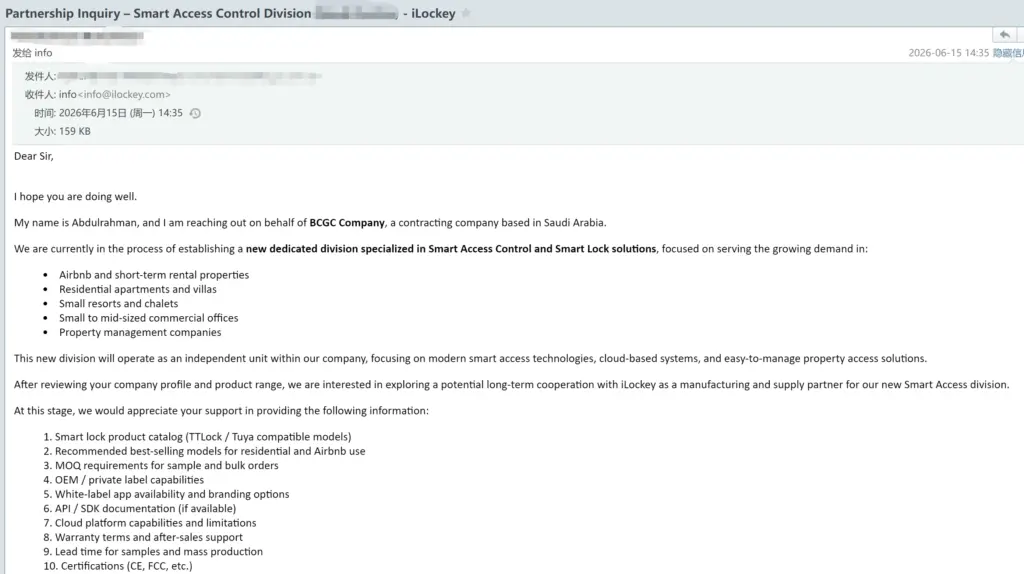
2) Apartment and Rental Property Access Inquiries
Apartment and rental property buyers often focus on remote access, temporary passwords, self check-in, cloud management, access logs, and multi-property management.
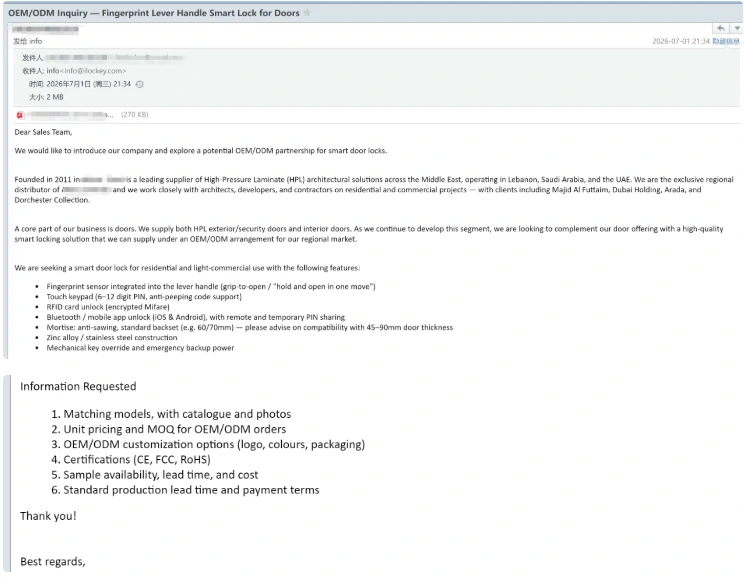
3) OEM/ODM Private Label Inquiries
Some of the common questions that distributors and smart home brands have about private label cooperation include MOQ, packaging, delivery lead time, datasheet, price list, warranty, and customization of the logo.
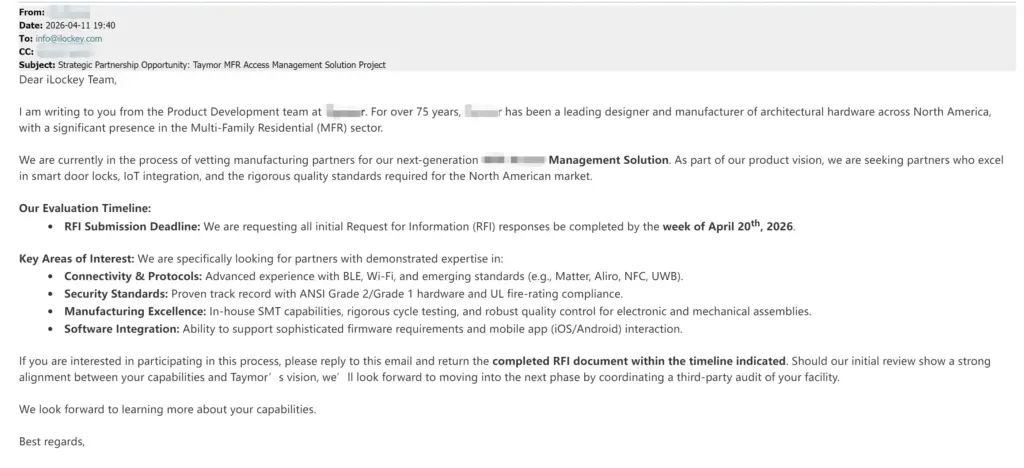
4) Certified Project Inquiries
Project buyers from North America, Europe, Australia, or other regulated markets may ask about UL, BHMA, CE, FCC, RoHS, EN1634-1, EN14846, fire-rated doors, ANSI mortise, or IP-rated outdoor locks.
11.Common Mistakes in Smart Lock Sourcing
Over the past decade or so, iLockey has served a wide range of clients. We have summarized below some common mistakes clients make when purchasing smart locks, for your reference.
- Mistake 1: Choosing Only by Price: The cheapest lock may create higher costs later if the software is unstable, the installation fails, or after-sales support is weak.
- Mistake 2: Ignoring Door Compatibility: Different markets use different door structures, mortise sizes, cylinders, and installation standards. Always confirm door thickness, backset, lock body, and opening direction before ordering.
- Mistake 3: Not Testing Samples: Photos and catalogs cannot replace real product testing. Always test samples before bulk orders.
- Mistake 4: Ignoring Software Requirements: For hotel, apartment, and commercial projects, software is not optional. It is part of the solution.
- Mistake 5: Confirming Integration Too Late: If the project needs PMS, API, smart home, or access control integration, technical feasibility should be confirmed before ordering.
- Mistake 6: Assuming All Certifications Apply to All Models: Certifications are usually model-specific. Always verify whether the certificate covers the exact product needed for the project.
- Mistake 7: Not Defining Warranty and Support Terms: Warranty, spare parts, and technical support should be confirmed before cooperation starts.
12. Why Choose iLockey as Your Smart Lock Manufacturing Partner?
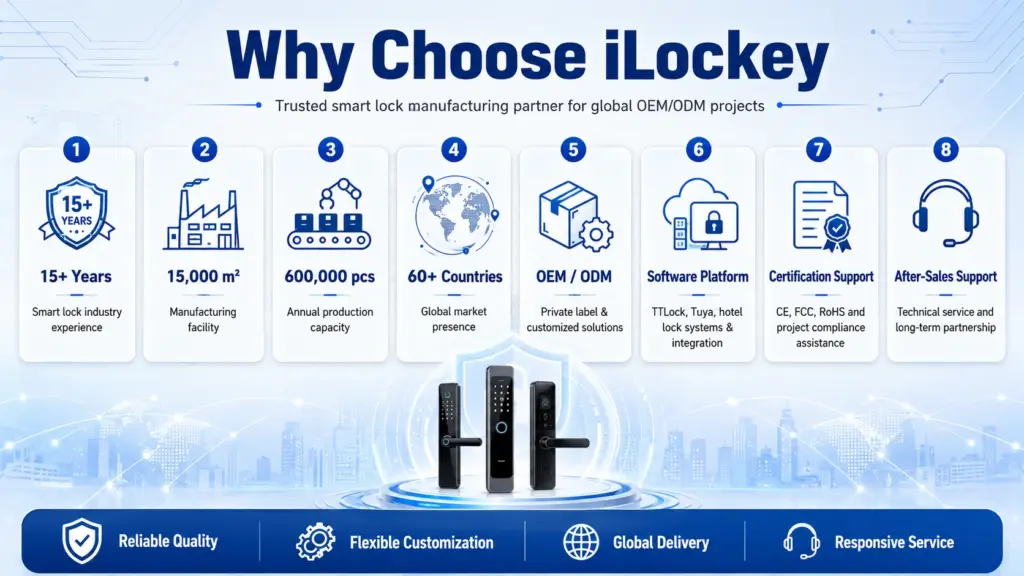
iLockey is a B2B smart lock and hotel lock manufacturer based in Shenzhen, China. With over 15 years of experience in smart access control and hotel lock manufacturing, we support global distributors, project contractors, hotel solution providers, smart home brands, and OEM/ODM customers.
Our key advantages include:
- Over 15 years of smart lock and hotel lock manufacturing experience
- Approximately 15,000 m² production base
- Annual production capacity of around 600,000 pcs
- Products and solutions supplied to customers in more than 60 countries
- B2B OEM/ODM project support
- Wide product range for hotels, apartments, homes, cabinets, lockers, and commercial access control
- Support for Tuya, TTLock, TThotel Bluetooth hotel lock system, RFID hotel lock software, and PMS integration evaluation for applicable hotel projects
- Certification support depending on product model and target market
- Sample testing and pilot project support
- Technical guidance and after-sales support for project customers
- Hotel system accessories including elevator control, energy-saving switch, and DND system
We understand that professional buyers do not only need a lock. They require a stable and practical access management solution that can be installed, managed, maintained and scaled.
From the perspective of source locks for a hotel project to develop a smart lock brand to upgrade the access management in an apartment to an OEM/ODM manufacturing partner, iLockey can assist you in selecting a suitable product based on your application scenario, door type, software requirements, certification requirements, and target market.
13. Smart Lock Sourcing FAQs
The following are some issues frequently encountered by iLockey during the course of providing services; I have compiled them here for your reference.
1)Should I choose OEM or ODM smart locks?
It depends on the business model.
If the buyer already has a clear product design, brand standard, and technical specification, OEM manufacturing may be suitable. If the buyer wants to launch a smart lock product line faster with lower development cost, ODM solutions based on existing mature models are usually more practical.
For most distributors and new brands, ODM is often a good starting point.
2)How long does smart lock production usually take?
Lead time depends on product model, order quantity, customization level, and production schedule.
For reference, standard sample lead time is usually around 3–7 working days depending on the model. Standard bulk order lead time is usually around 15–25 working days depending on model, quantity, and customization level.
Customized packaging, software branding, certification requirements, or new tooling may require additional time.
3)What is the MOQ for OEM smart locks?
MOQ depends on the product model and customization requirement.
For reference, OEM logo customization usually starts from 100 pcs. Private label packaging usually starts from 500 pcs. App customization or software branding should be evaluated and quoted separately. New tooling MOQ depends on the actual project scope.
4)Can I customize the lock with my own brand?
Yes, in many cases.
OEM/ODM customization may include logo, packaging, manual, color, function configuration, and sometimes app or software branding. The available customization options depend on the model, order quantity, and project requirements.
5)Can smart locks support mobile app and remote control?
Yes, many smart locks can support mobile app control. Remote control usually depends on the communication protocol and whether a gateway or cloud platform is used.
For example, Bluetooth locks usually support local app control. Remote control may require a gateway. Wi-Fi locks may connect directly to the network but may have different battery consumption considerations.
Functions may vary by model, gateway, and software platform.
6)Does iLockey support Tuya and TTLock smart locks?
Yes. iLockey can provide Tuya and TTLock smart lock solutions depending on the product model and project requirements.
Buyers should confirm the required functions, gateway needs, app operation, and target market before sample ordering.
C7)an hotel locks integrate with PMS systems?
For hotel projects, PMS integration may be possible depending on the hotel lock system and project requirements. iLockey can evaluate PMS integration requirements for applicable hotel projects, including projects involving Opera, Fidelio, or other hotel management platforms.
Buyers should confirm PMS brand, integration method, technical documents, and project scope before ordering.
8) Are Chinese smart lock manufacturers reliable?
China has a well-developed supply chain for smart locks, and a lot of experienced manufacturers. Yet there are a lot of variations in the capabilities of suppliers.
Customers must consider product quality, software platform, certification support, project experience, production capacity and after-sales service before choosing a product.
9)What certifications are required for smart locks?
Requirements for certification vary depending on the market and use of the product.
CE, FCC, RoHS, UL, BHMA, EN1634-1, EN14846, fire rated test reports or IP-rated test reports are some of the common certifications. Don’t assume that the certificate is for the specific model you intend to buy.
10)Should I focus more on hardware or software?
Both are important. The reliability of installation and use of the lock depends on the hardware. Whether it is possible to manage the lock efficiently depends on the software. Software capability and system integration are equally significant as the hardware quality for hotel, apartment and commercial projects.
11)What is the biggest risk in smart lock sourcing?
The biggest risk is choosing a supplier only based on price without checking software reliability, door compatibility, certification, sample performance, and after-sales support.
Smart locks are connected products. A successful project requires both reliable hardware and a stable management system.
12)How can I start a smart lock sourcing project with iLockey?
You can provide us with the information of your project: Application scenario, target market, Door type, required functions, software requirements, certification requirements, and estimated quantity, etc.
Our team will assist in the evaluation of suitable models, technical information and support for sample testing prior to mass production.
14. Conclusion
As an experienced smart lock and hotel lock manufacturer, iLockey is ready to support global buyers with OEM/ODM smart lock solutions for hotels, apartments, residential homes, commercial buildings, cabinets, lockers, and access control projects.
If you are looking for a smart lock manufacturing partner, contact iLockey with your project requirements. We will help you find the most suitable solution for your market and application.