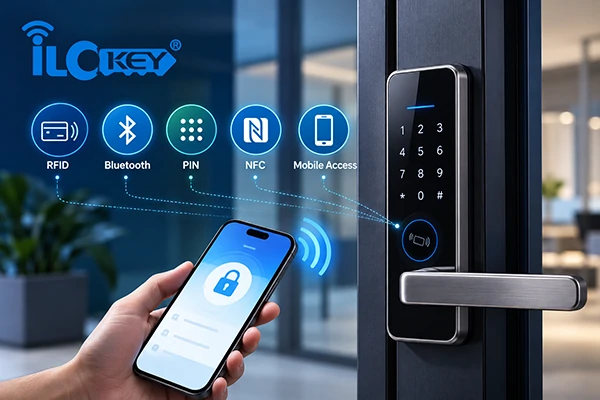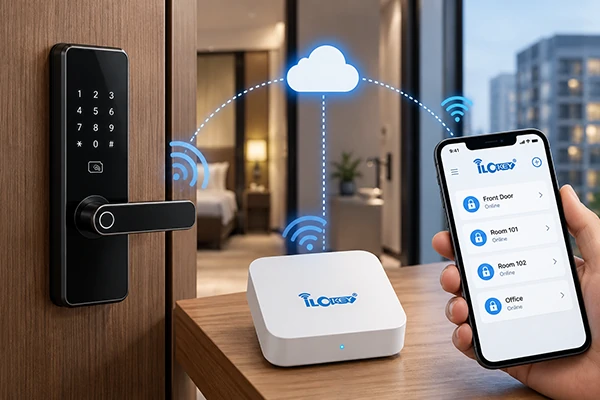
Glass doors are widely used in offices, meeting rooms, retail stores, showrooms, hotels and public buildings because they make an entrance feel open and modern. Adding intelligent access, however, is not as simple as fitting a conventional smart lock designed for a timber or steel door.
The correct solution will depend on the entire door assembly – whether the door swings or slides, whether it is framed or frameless, the thickness of the glass, the gap between the door and the closed location, the strike position, condition of the floor spring or hinges, and the traffic level and the access-management workflow. The type of lock that appears to fit in a product photograph might not actually fit the door safely and/or it may not line up after several months of use.
This guide first explains the full category of smart locks and access-control solutions for glass doors. It then uses the iLockey G5 as a detailed example of one specific branch: a battery-powered, clamp-on solution for compatible indoor frameless glass swing-door retrofit projects.
| Project condition | Usually suitable approach | Main reason |
| Frameless swing door, retrofit, no wiring | Clamp-on battery smart lock | Avoids routing cables and may avoid drilling compatible glass |
| High-traffic entrance or central security system | Wired reader plus electric bolt or magnetic lock | Supports continuous power, monitoring, and system integration |
| Framed or narrow-stile glass door | Profile-specific smart lock or access hardware | Fits the frame cavity, backset and existing preparation |
1. Why Glass Doors Need a Dedicated Locking Strategy
Before selecting a lock for a glass door, it is important to understand the material limitations and how the complete door assembly affects installation, alignment, and long-term operation.
1) Finished Tempered Glass Cannot Be Treated Like Timber or Metal
A timber or metal door can often be drilled, routed, or prepared on site for a mortise lock. Finished tempered glass is different. The holes, notches, and edgework required by the hardware must normally be completed before the glass is tempered.
ASTM C1048 states that cutting, drilling, notching, and edgework must be performed before strengthening or tempering.
If an installed tempered-glass panel does not already have the holes required by a traditional lock, attempting to machine it on site can destroy the panel. The realistic choices are therefore a no-glass-drilling solution, compatible use of existing factory holes, or replacement with newly prepared glass.
2) The Door Assembly Matters as Much as the Lock
A glass door is a moving system. Floor springs, pivots, top and bottom patches, hinges, frames, fixed panels and door stops determine where the door returns when it closes. Heavy glass doors can gradually sag or move out of alignment. Even a small change can prevent an electric bolt from entering its receiver or can leave a clamp-on latch misaligned with its strike.
For this reason, a site survey must evaluate the door in its current condition. Installing a new lock cannot compensate for a worn floor spring, loose patch fitting, twisted frame or door leaf that does not close consistently.
2. Main Types of Smart Locks and Access Control for Glass Doors
The following sections compare the main locking architectures for glass doors and explain where each solution is most suitable.
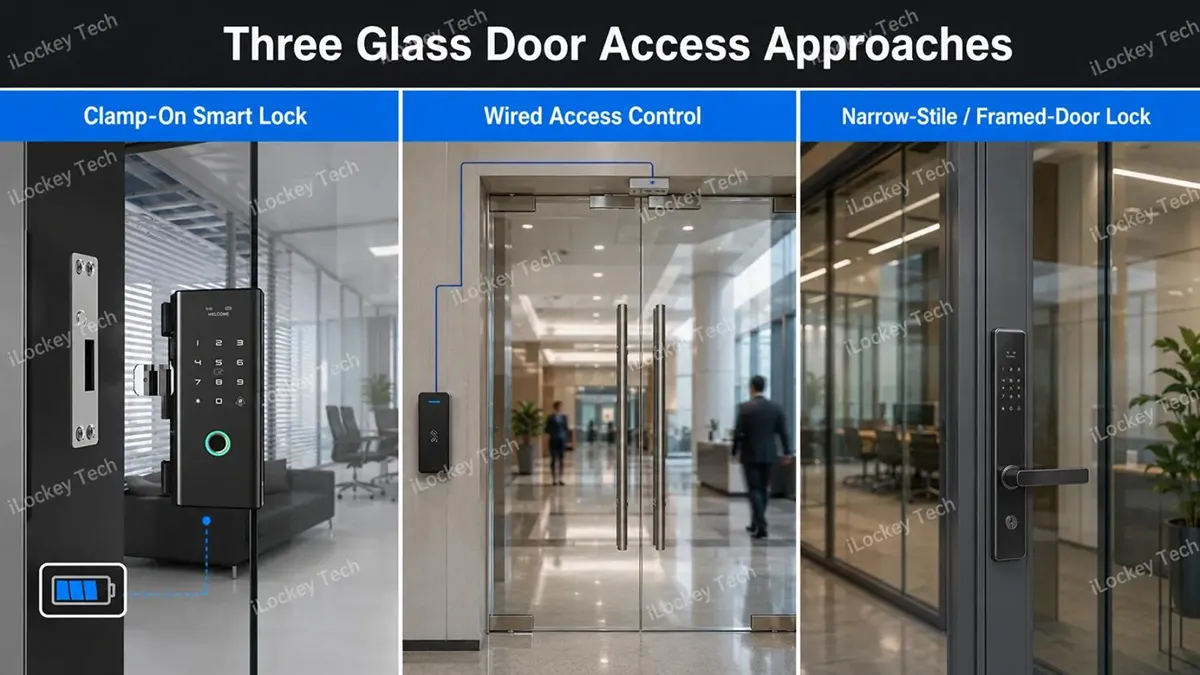
1) Clamp-On Battery Smart Locks
A clamp-on smart lock combines the keypad or credential reader, controller, locking mechanism, and batteries in one door-mounted product. It is usually the simplest retrofit approach for a compatible frameless swing door because it can avoid power cabling and, with the correct fitting, avoid drilling through the glass.
Its strengths are fast deployment, a clean retrofit, and multiple credentials such as PIN, card, fingerprint, or app access. Its limitations are equally important: the clamp must match the glass thickness, the door gap and strike geometry must be suitable, the product must tolerate repeated door movement, and batteries must be maintained.
2) Electric Bolts and Electromagnetic Locks
A wired access-control system separates the credential reader from the locking hardware. Depending on the door, the locking element may be an electric drop bolt, an electromagnetic lock or other glass-door-compatible hardware mounted at the frame, header, floor, or patch fitting. If you would like to learn more about magnetic door locks, we have created a dedicated guide: Magnetic Door Lock: An Ultimate Guide, which you can view.
This architecture is normally better suited to high-traffic entrances, centralized security, time schedules, alarm inputs, or integration with an existing building system. It requires a stable power supply, cable routes, a controller, exit devices, and commissioning. Bolt alignment is especially sensitive to door sag or a floor spring that no longer returns the door to the same position.
3) Smart Locks for Framed and Narrow-Stile Glass Doors
Narrow-profile mortise locks, smart locks, electronic cylinders, electric strikes or multi-point locks are available to be fitted into aluminium framed glass doors. Smart locks are smart enough because they are intended for use on glass doors, but they can be physically too large because modern narrow-stile profiles can be just a few centimetres wide.
Selection must be based on the frame cross-section, backset, spindle or cylinder standard, existing holes, latch position and cable space. A lock designed for an unframed glass edge should not automatically be transferred to a narrow aluminium profile.
| Solution | Best fit | Power | Main advantage | Watch point |
| Clamp-on smart lock | Compatible frameless swing-door retrofit | Battery | Reduced wiring and fast retrofit | Glass thickness, gap, strike and battery maintenance |
| Electric bolt / magnetic lock | High-traffic or centrally managed access | Wired | Monitoring, schedules and integration flexibility | Cabling, power, egress design and alignment |
| Framed / narrow-stile lock | Aluminium-profile glass door | Battery or wired | Integrated appearance and profile fit | Backset, frame cavity and existing preparation |
3. Which Glass Door Types Can Use Smart Locks?
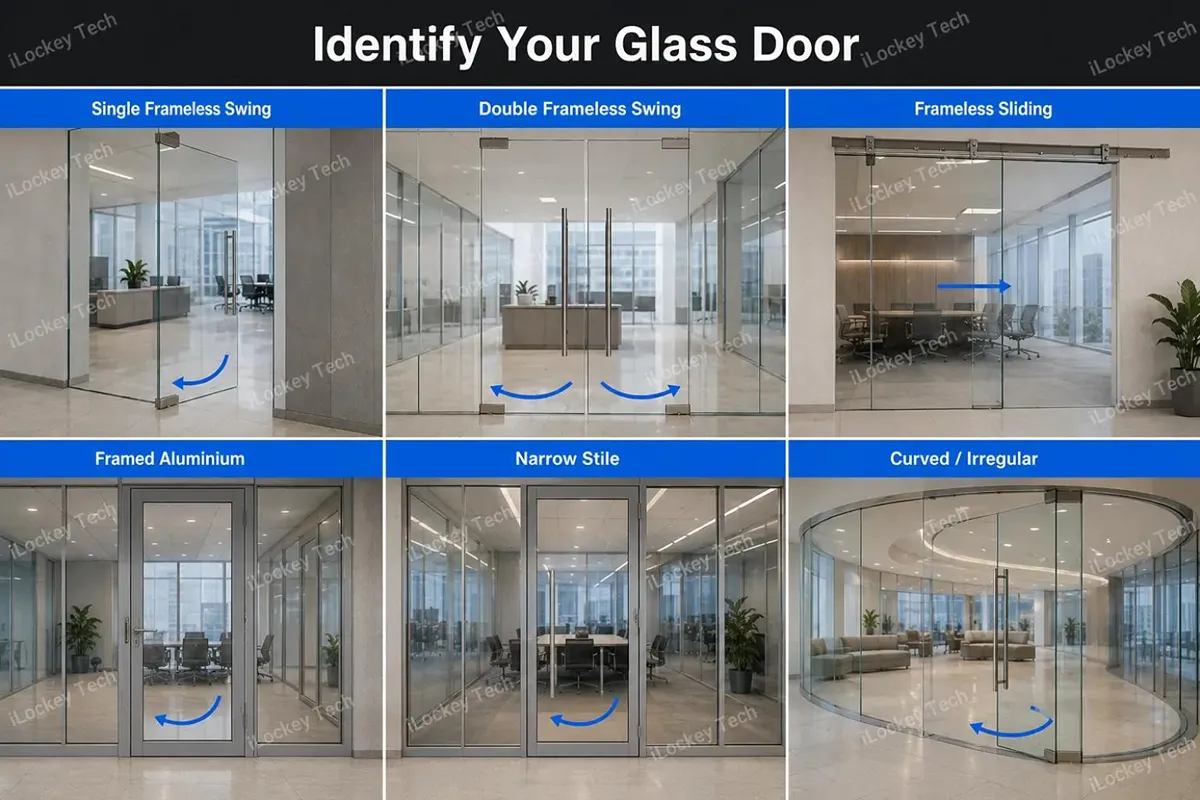
“Glass door” describes several different constructions. The opening method and the fixed structure beside the moving leaf determine where the lock and receiver can be installed.
| Door type | Suitability | Common approach | Important check |
| Single frameless swing door | Good | Clamp-on lock or wired glass-door hardware | Wall, frame or fixed-glass strike position |
| Double frameless swing door | Good with correct fittings | Main lock plus glass-to-glass strike, or one leaf fixed | Active and inactive leaf movement and alignment |
| Frameless sliding door | Model-specific | Sliding-door electric lock or operator-integrated access | Travel direction, overlap and automatic operator |
| Framed aluminium glass door | Good | Profile-specific lock, strike or access control | Frame cavity, backset and existing preparation |
| Narrow-stile glass door | Model-specific | Narrow-body mortise, cylinder or strike solution | Very limited mounting width and cable space |
| Curved or irregular glass door | Difficult | Custom-engineered solution | Non-flat clamping surfaces and special glass preparation |
| Thin or damaged glass | Not recommended without engineering review | Replace or reinforce the door assembly | Glass strength, edge damage and hardware load |
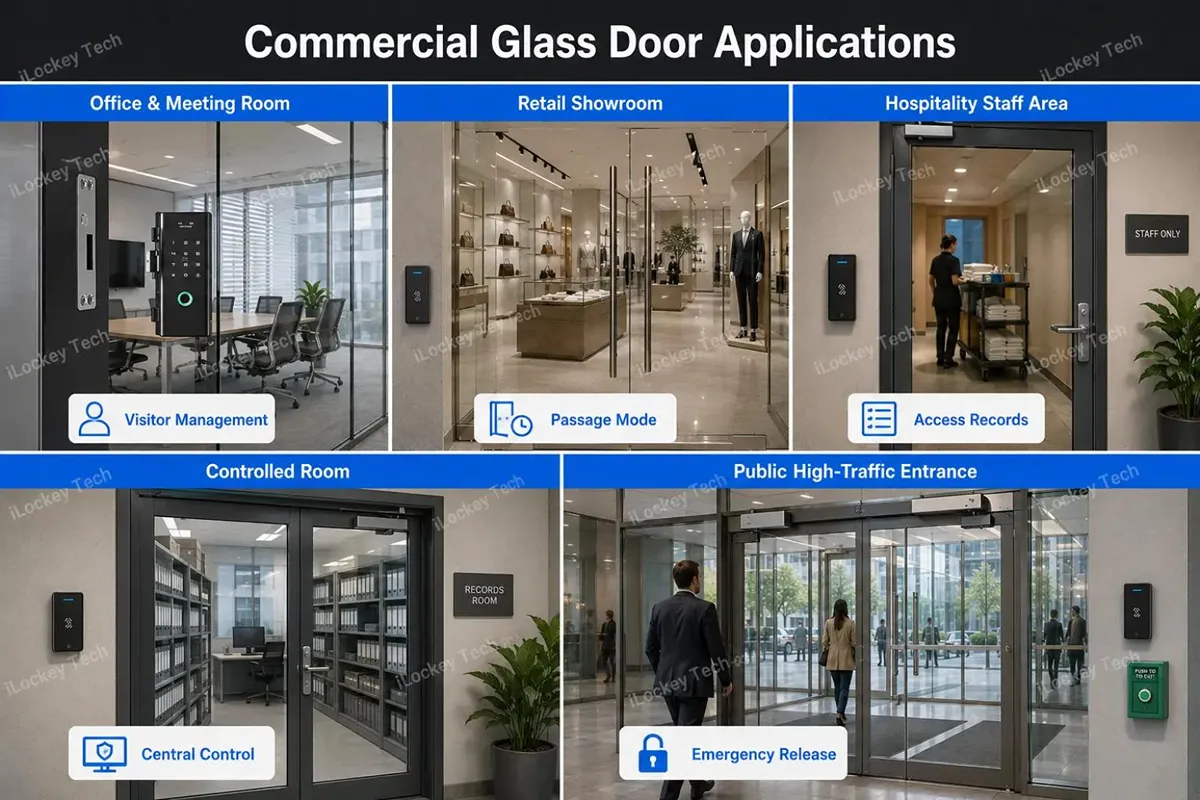
4. Typical Commercial Applications and Their Real Priorities
The following applications show how glass-door lock requirements can vary significantly with traffic levels, access policies, operating hours and safety requirements.
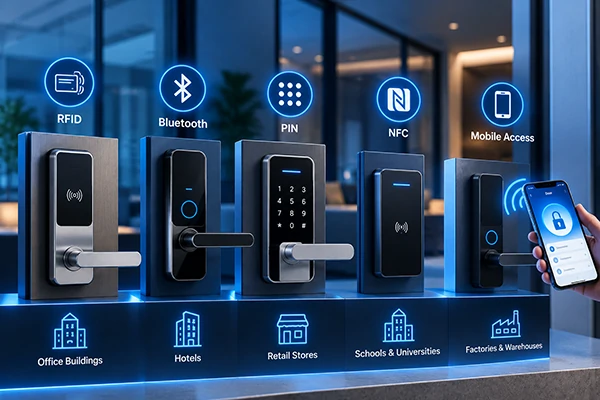
1) Offices, Meeting Rooms and Coworking Spaces
Office glass doors need a balance of appearance, simple employee access, visitor management and predictable daily operation. Fingerprint, PIN, RFID or mobile credentials may all be relevant. Passage Mode is valuable during arrival periods or business hours because the door can remain freely accessible for an approved period and return to controlled access afterward.
2) Retail Stores and Showrooms
Retail entrances may experience concentrated traffic during opening hours and require stronger control after closing. A low-traffic internal showroom door may suit a battery clamp-on lock, while a main entrance with hundreds of daily movements may justify continuous power, a door sensor and centralized scheduling.
3) Hotels, Serviced Apartments and Hospitality Areas
Reception offices, restaurant partitions and staff-only glass doors may use commercial access control, but guest-room systems, balcony doors, pool areas and emergency exits have different environmental and operational requirements. A general glass-door lock should not be presented as a substitute for a hotel guest-room platform or a verified outdoor product.
4) Laboratories, Clinics and Controlled Rooms
These projects may prioritize permissions, access records and contact-reduced operation. The required hardware still depends on the complete door and local compliance requirements. A product should not be described as medical, clean-room or laboratory certified unless the specific documentation supports that claim.
5) Public Buildings and Transport Facilities
For public access, typically a high frequency is matched by a desire for durable wired hardware, door status monitoring and a well-thought-out emergency-release progression. The access-control specification must be synced with fire and life safety design of the building and not made as a stand-alone smart-lock purchase.
5. Installation Requirements That Decide Whether a Project Will Work
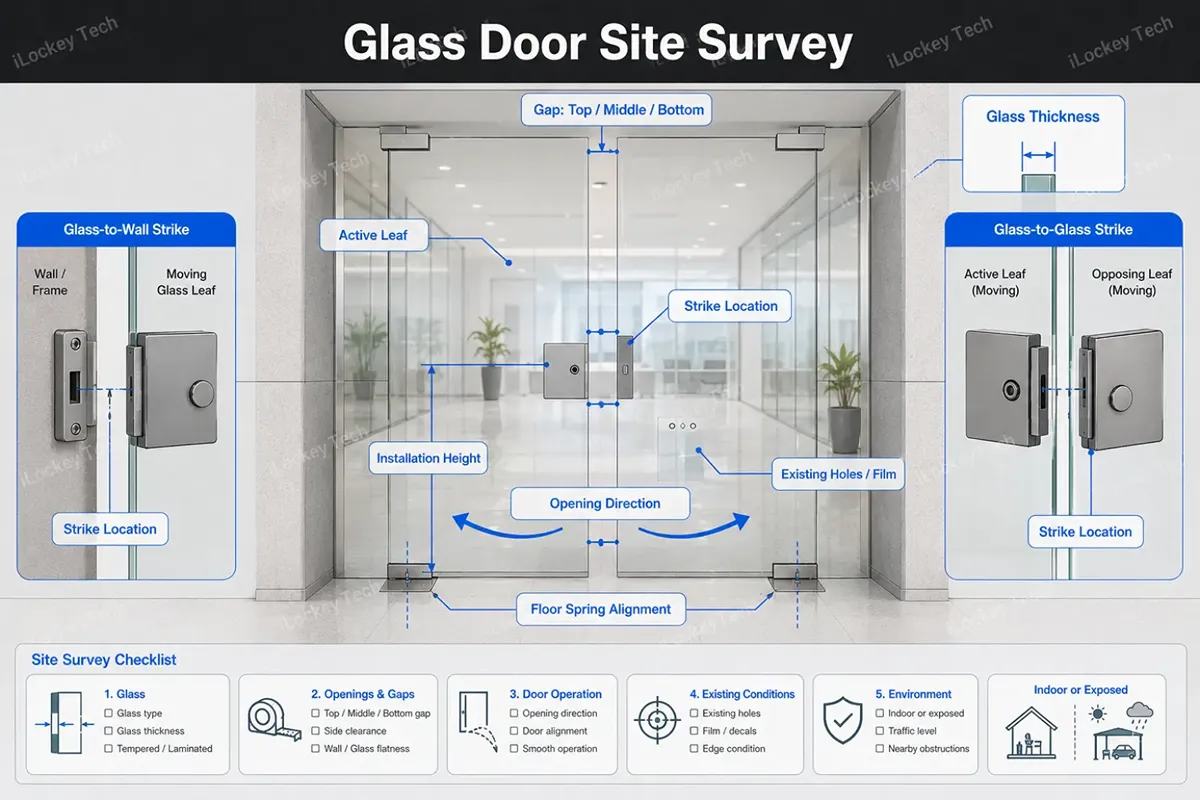
iLockey suggests the following installation factors should be verified on site before product selection and production, as they directly affect fit, alignment, power, emergency operation and compliance.
1) Glass Type, Thickness and Existing Preparation
Confirm whether the door is tempered glass, laminated glass, or another construction; measure the actual thickness; inspect the edge for chips, film, bevels, or patch fittings; and record all existing holes. Do not use a generic thickness range from another lock model. The clamp, gaskets, and strike must be specified for the actual glass.
2) Door Gap and Closing Alignment
Take measurements of the gap between the door and the frame at the top, middle, and bottom of the frame. If the gap is too narrow, it can create a misalignment between the lock or strike and the adjacent panel. If the gap is too wide, it may decrease the degree of engagement with the latches or resistance to manipulation. The range is different for each product, and the supplier needs to check for the model being quoted.
Check whether the gap changes as the door moves and whether the leaf returns to the same closed position. If the floor spring, hinge, or pivot is worn, correct the door before installing the lock.
3) Opening Direction, Active Leaf and Strike Location
For a single door, determine whether the strike will be mounted on a wall, frame or fixed glass panel. For double swing doors, identify the active leaf and decide whether the second leaf will be fixed by top and bottom bolts or receive a glass-to-glass strike box. Confirm the secure side and left- or right-hand orientation before production.
4) Power, Cabling and Emergency Access
Battery locks reduce construction work, but battery life depends on opening frequency, motor load, wireless activity, temperature and user behaviour. High-frequency entrances may be better served by wired hardware. For powered systems, confirm the power supply, backup battery, cable path, door loop or concealed transfer, controller location and emergency-release method.
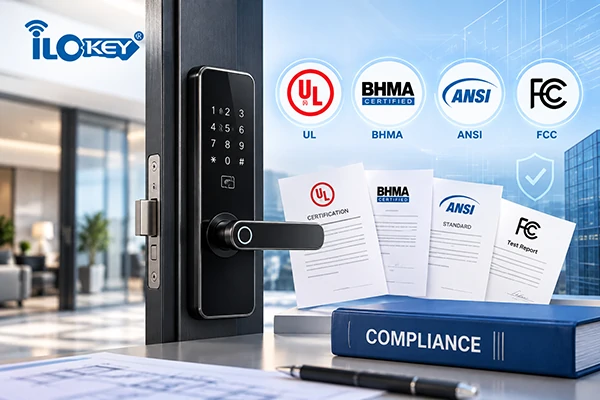
5) Egress, Fire and Local Compliance
Fail-safe and fail-secure are project decisions, not marketing labels. On an escape route, free egress, emergency release, power-loss behaviour and fire-alarm interaction must be coordinated with local codes and the complete door assembly.
A lock with an internal knob or emergency power input is not automatically a fire-rated or code-compliant egress solution. The project designer, local installer and relevant authority must approve the complete opening.
6. A Four-Step Method for Selecting the Right Glass Door Lock
The following four-step method provides a practical sequence for moving from door assessment to lock selection, system configuration and final project verification.
1) Step 1: Identify the Door
Confirm swing or sliding, single or double, framed or frameless, glass thickness, gap, opening direction and the fixed structure that will receive the strike. Photographs should show the complete door from both sides, the top and bottom hardware, the edge and the closed-door joint.
2) Step 2: Define Traffic and Operating Workflow
Estimate daily openings, peak periods and the consequence of downtime. A private meeting room and a main office entrance may both have glass doors but require different power and maintenance strategies. Decide whether Passage Mode, automatic relocking, schedules, door-status monitoring or a staffed remote-release workflow is required.
3) Step 3: Choose Credentials and Management Architecture
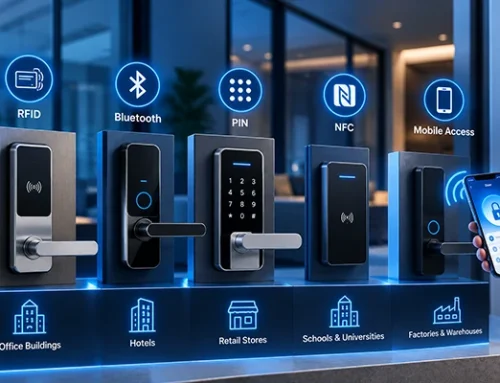
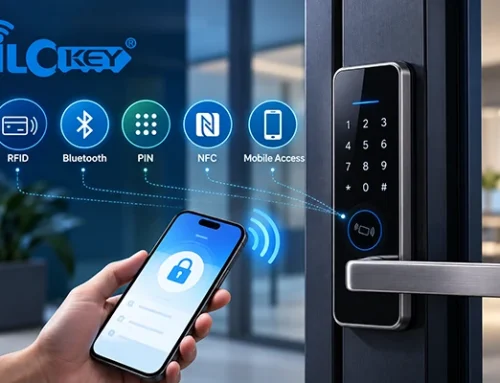
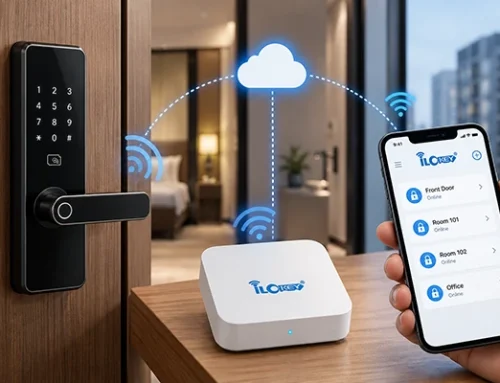
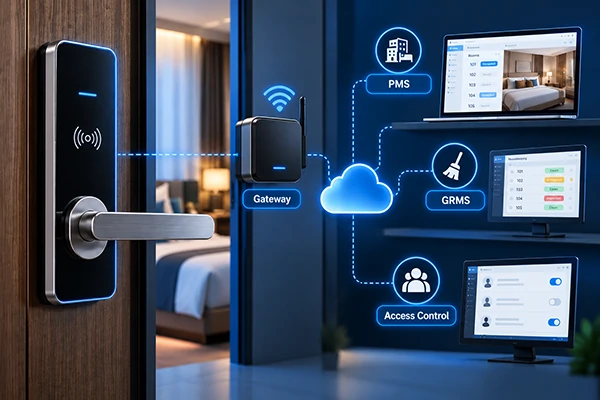
Choose fingerprint, PIN, RFID, Mobile credentials or all above depending on the user groups. After, then you’ll consider whether the project requires stand-alone management, Bluetooth administration, Wi-Fi or Zigbee connectivity, a gateway, RS485 or Wiegand interfaces, centralized card issuing, temporary credentials or access logs or third-party integration. Such capabilities are model and platform dependent and will need to be verified in the quotation.
4) Step 4: Confirm Installation, Compliance and Commercial Scope
Confirm who supplies the strike, power supply, controller, exit button, emergency release, cables and mounting accessories. Identify who will adjust the glass door, perform electrical work, commission the software and approve local compliance. A complete quotation should separate product price, accessories, installation, software, shipping and any recurring service fee.
Practical selection rule: Choose the door and operating workflow first. Select the lock only after the physical fit, power architecture, credentials, management platform and compliance path are confirmed.
7. iLockey G5: A Practical Clamp-On Retrofit Example
The following G5 example shows how a clamp-on glass-door smart lock can be evaluated in a real retrofit project, from physical compatibility and installation to credentials and daily management.
1) Where the G5 Fits
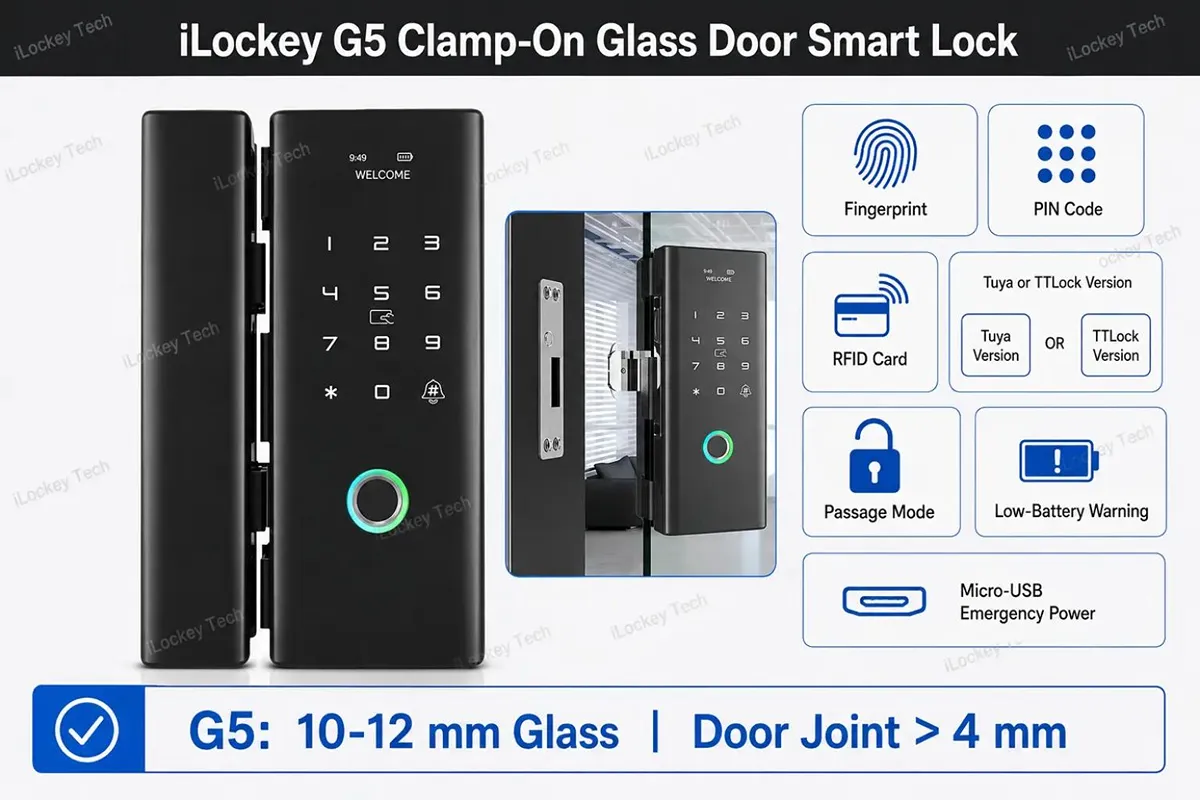
The iLockey G5 is a standalone, battery-powered clamp-on smart lock for compatible glass doors. Its strongest use case is an indoor or weather-protected frameless glass swing door where the buyer wants fingerprint, PIN, RFID and app management without routing a power cable to the moving leaf.
For frameless installation, the supplied G5 instructions specify 10-12 mm glass and a closed-door joint greater than 4 mm. These are G5 requirements, not universal glass-door standards. The standard package includes a glass-to-wall strike plate and a glass-to-glass strike box, allowing single-opening and double-glass configurations when the door and fittings are confirmed.
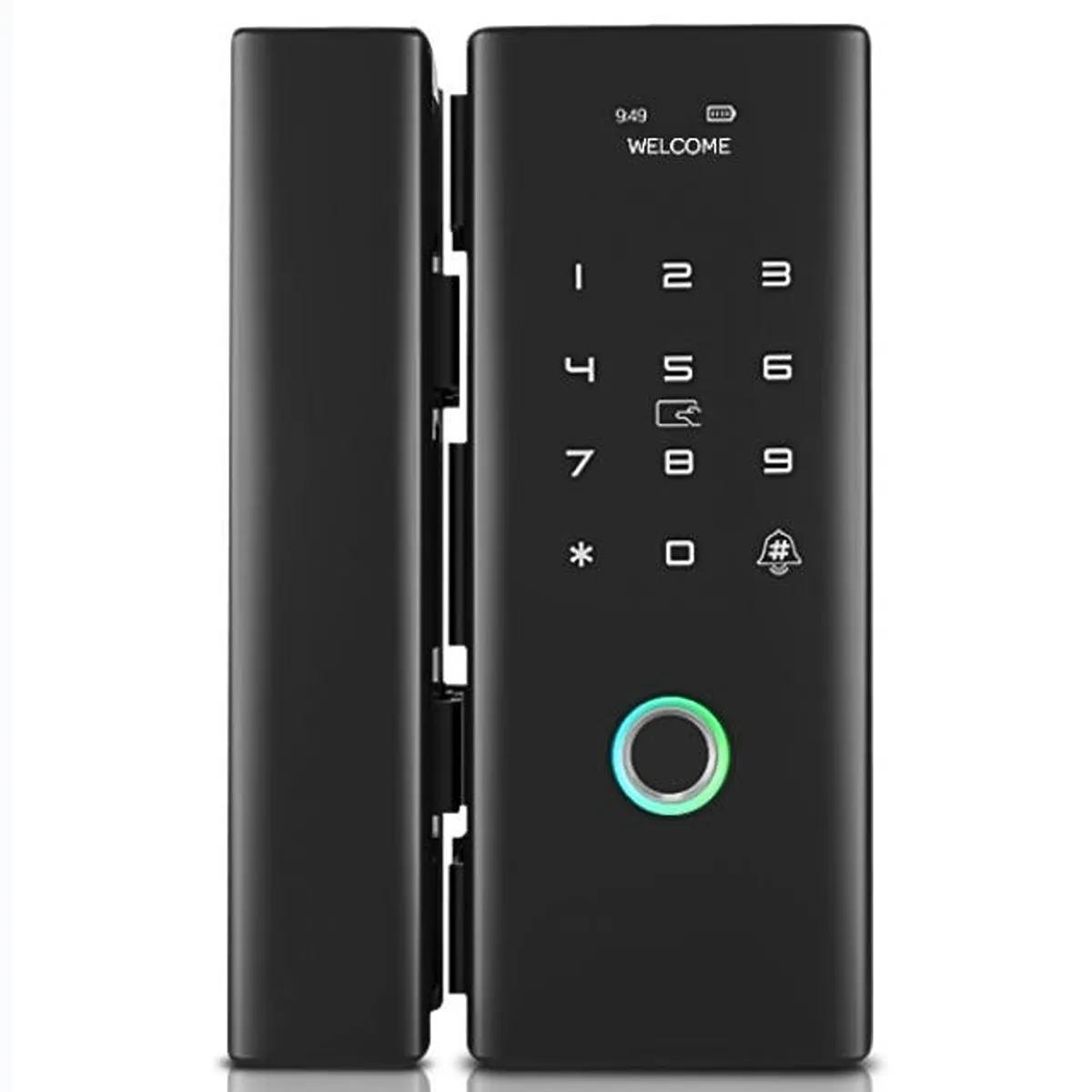
| Product type | Standalone clamp-on glass-door smart lock |
| G5 frameless requirement | 10-12 mm glass; closed-door joint greater than 4 mm |
| Door configurations | Glass-to-wall and glass-to-glass fittings supplied |
| Unlocking methods | Fingerprint, PIN, RFID card and app; optional remote control |
| Platform versions | Tuya and TTLock versions are identified; confirm the quoted version and functions |
| Power supply | 4 × 1.5 V AA alkaline batteries |
| Emergency power | Micro-USB input from a power bank |
| Fingerprint capacity | 200 |
| PIN + RFID capacity | 1,000 combined users |
| Administrator capacity | 9 |
| Optional remote capacity | 50 |
| Recognition / unlocking | Fingerprint recognition ≤0.3 seconds; total unlocking stated as 1-1.5 seconds |
| Material / colour | Zinc alloy and ABS / black |
| Documented operating functions | Automatic locking, Passage Mode, low-battery warning, anti-peeping PIN, wrong-attempt lockout and doorbell |
 2) G5 Installation Logic
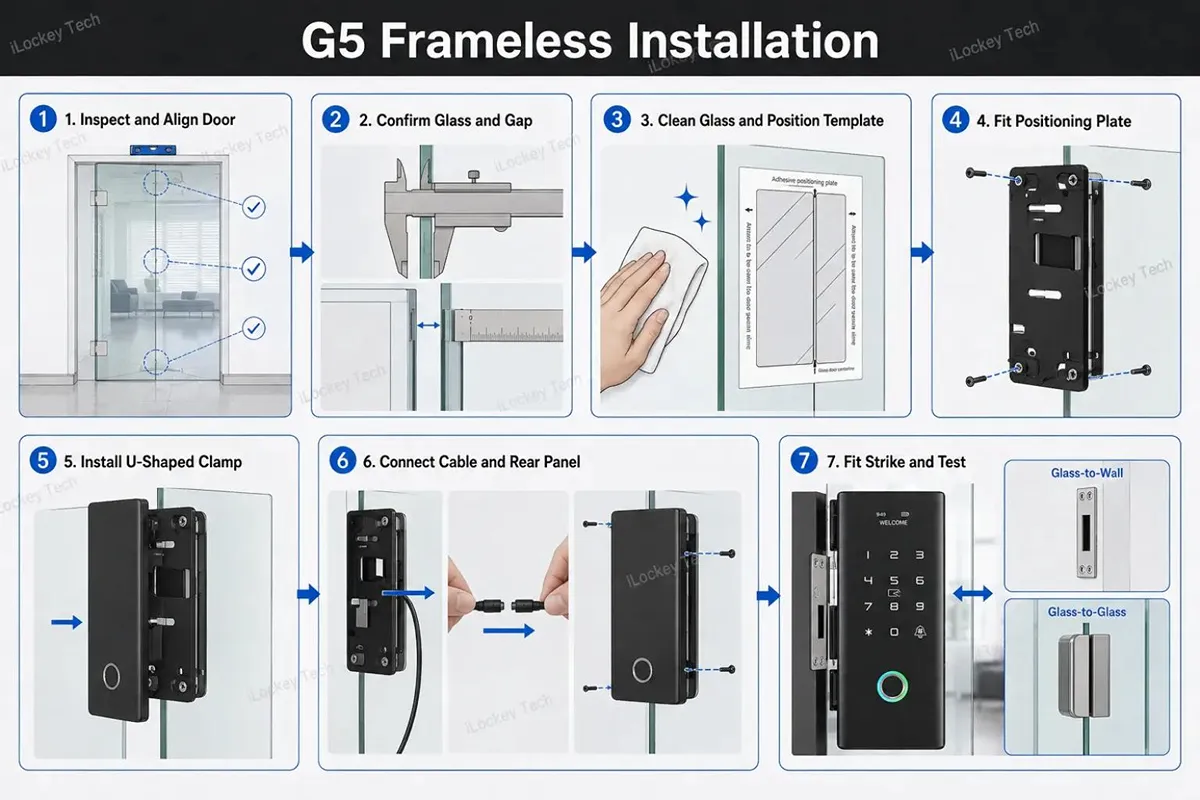
The no-glass-drilling design reduces retrofit work, but installation still requires careful preparation. The door must first be level, clean and stable. The installer uses the positioning template, fixes the positioning plate, slides the U-shaped clamp over the glass edge, tightens the four screws evenly, connects the front and rear-panel cable, installs the rear panel and aligns the correct strike.
1. Inspect the door, glass edge, floor spring and closed position.
2. Confirm 10-12 mm glass and a closed-door joint greater than 4 mm for the documented frameless G5 installation.
3. Clean the glass and position the supplied template.
4. Fit the positioning plate and U-shaped clamp, tightening the four screws evenly.
5. Connect the cable without pinching or twisting it, then fit the rear panel.
6. Install the glass-to-wall strike plate or glass-to-glass strike box.
7. Test alignment, automatic locking, every credential, Passage Mode and emergency power.
The manual allows the U-shaped bracket to be removed, turned 180 degrees and replaced if it is reversed in its direction. To guarantee the correct fitting for framed glass, aluminium doors or timber doors, check all fitted and pre-cut holes prior to order.
3) Credentials and Daily Management
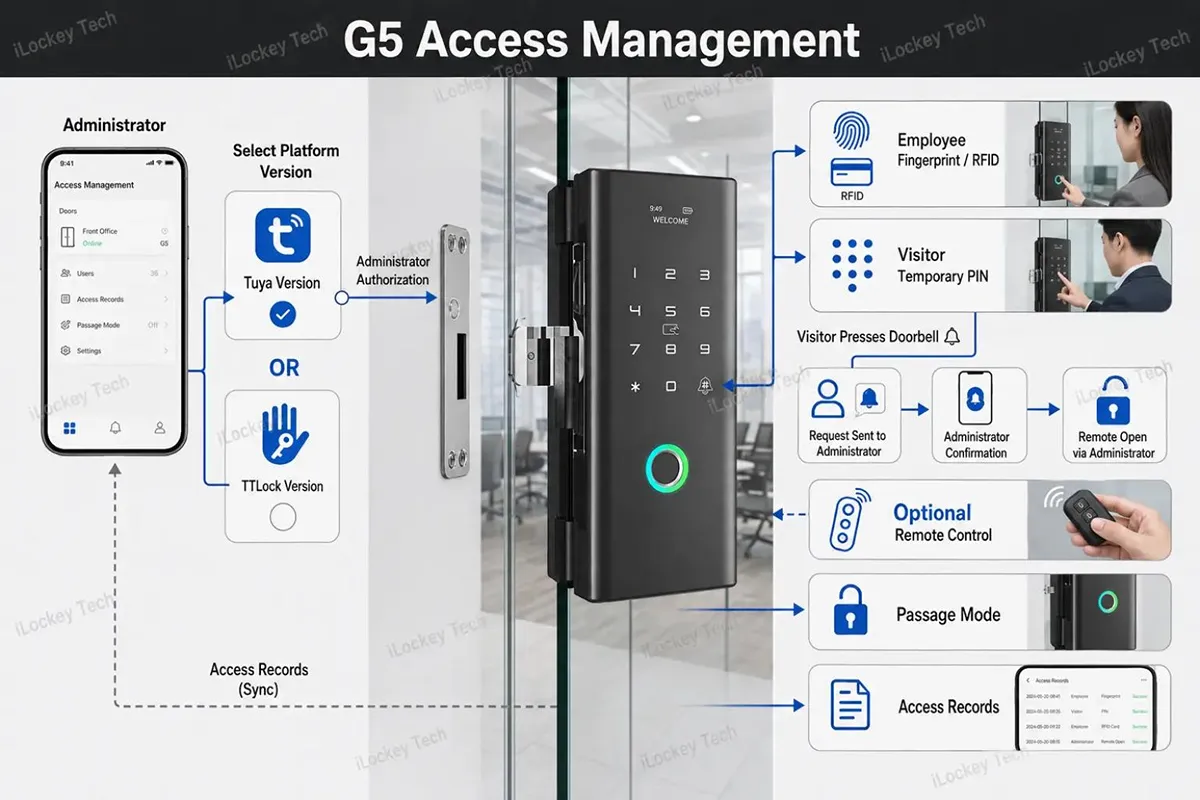
At the door, the G5 supports fingerprint, PIN and RFID access. The product presentation identifies Tuya and TTLock platform versions, but buyers should confirm the exact version, app functions, gateway requirements and service conditions in the quotation rather than assuming both platforms work identically.
In the supplied Tuya manual, temporary codes can be created for defined periods, with up to 10 temporary-code groups stated. The documented remote-opening workflow begins when a visitor activates the doorbell and the administrator confirms access in the app. An optional handheld remote can also be enrolled where required.
Passage Mode can keep the door freely accessible during approved periods and return it to controlled access later. The G5 also documents an anti-peeping PIN function, a low-battery warning and a 90-second keypad lockout after more than five consecutive incorrect password attempts. If the batteries are depleted, a power bank can supply temporary power through the Micro-USB input.
4) Where the G5 Should Not Be Used Without Further Review
The supplied materials do not establish the G5 as an exposed outdoor, waterproof, fire-rated or fire-alarm-integrated product. It should not be assumed suitable for automatic sliding doors, curved glass, escape routes, pool areas or other wet locations. Those applications require separately confirmed hardware and project engineering.
8. B2B Procurement: Price, Samples, OEM/ODM and Project Rollout
The following are our suggestions on glass door lock B2Bprocurement.
1) Compare the Complete Installed Cost
Do not compare lock-body prices alone. A clamp-on product quotation should identify the correct strike or strike box, batteries, optional remote, app or platform conditions, spare units, packaging and installation. A wired system should additionally include readers, controllers, power supplies, backup batteries, exit devices, cabling, installation and commissioning.
2) Start with a Representative-Door Pilot
For a new project or distributor evaluation, test one or two representative doors before a batch order. The pilot should confirm the physical fit, closing alignment, credential enrolment, temporary-code workflow, Passage Mode, low-battery warning, emergency power and administrator handover. The approved product version, fittings, colour, platform and packaging should then be frozen for production.
3) Define the OEM/ODM Scope Before Quotation
Standard models normally allow a faster sample and lower starting quantity than customized products. Logo, packaging, colour, special glass fittings, firmware changes, platform integration or a new mechanical structure can affect MOQ, tooling, engineering time and lead time. A professional RFQ should separate standard product supply from OEM branding and deeper ODM development.
4) Payment, Delivery and Warranty
For standard OEM/ODM orders, iLockey normally works with a 30% deposit and 70% balance before shipment, subject to the confirmed quotation or proforma invoice. Large projects may be delivered in stages when this is agreed in the contract and production plan.
iLockey’s standard warranty is one year from the customer’s receipt date. For confirmed product quality issues within the warranty period, iLockey bears the related international transportation costs. The warranty does not automatically cover local installation labour, incorrect glass processing, unsuitable door conditions, unauthorized modification or installation outside the specified requirements.
9. Common Selection Mistakes
When purchasing smart locks for glass doors, our customers often overlook the following factors during the selection process.
| Mistake | Better practice |
| Buying a conventional smart lock and planning to drill the glass on site | Finished tempered glass may break; use a compatible clamp-on solution, existing factory holes or newly prepared glass. |
| Measuring the door gap only once | Measure at the top, middle and bottom and observe whether the gap changes through the closing cycle. |
| Ignoring door sag and floor-spring wear | A new lock will not correct a door that cannot return to a repeatable closed position. |
| Choosing battery power only to avoid wiring | Consider traffic, battery-replacement access and downtime; a high-traffic entrance may justify wired hardware. |
| Assuming every app version has the same functions | Confirm the selected platform, remote workflow, records, gateway and service conditions in the quotation. |
| Treating an internal knob as proof of egress compliance | Approve the complete door, emergency release and fire/life-safety sequence with the relevant local parties. |
| Using product price as the complete project budget | Include fittings, electrical work, glass work, installation, software, spares, shipping and commissioning. |
10. Smart Locks for Glass Doors FAQs
There are some common questions about Smart Locks for Glass Doors.
1) Can any smart lock be installed on a glass door?
No. The lock must match the opening method, frame or frameless construction, glass thickness, gap, strike position and existing preparation. A residential mortise lock is not automatically suitable.
2) Can tempered glass be drilled after installation?
Finished tempered glass should not be cut or drilled on site. Required holes and notches are normally prepared before tempering. If the glass is not prepared, use a compatible no-drilling solution or replace the panel with factory-prepared glass.
3) Which solution is best for a high-traffic glass entrance?
A wired access-control system with appropriate electric locking hardware is often more suitable because it provides continuous power, monitoring and integration options. Final selection depends on the door and compliance design.
4) Can a double glass door use a clamp-on smart lock?
Yes, if a compatible glass-to-glass strike solution is available and the active and inactive leaves are stable. In some projects one leaf is fixed with top and bottom bolts and the other carries the main lock.
5) Does the iLockey G5 require drilling through the glass?
The documented frameless installation uses a positioning plate and U-shaped clamp without drilling through compatible glass. It requires 10-12 mm glass and a closed-door joint greater than 4 mm.
6) Does the G5 support both Tuya and TTLock?
The product presentation identifies Tuya and TTLock platform versions. The quoted version and its exact app, gateway, remote and temporary-code functions must be confirmed before ordering.
7) What happens when the G5 batteries are depleted?
G5 runs on 4 AA alkaline batteries and has a Micro-USB emergency power input port. A power bank can provide power in case to unlock the door whilst the batteries are being replaced by an authorized user.
8) Is the G5 suitable for outdoor or fire-door projects?
The supplied G5 materials do not present it as an exposed outdoor, waterproof, fire-rated or fire-alarm-integrated product. Those applications require separately verified products and complete project approval.
9) What information should a buyer send for a quotation?
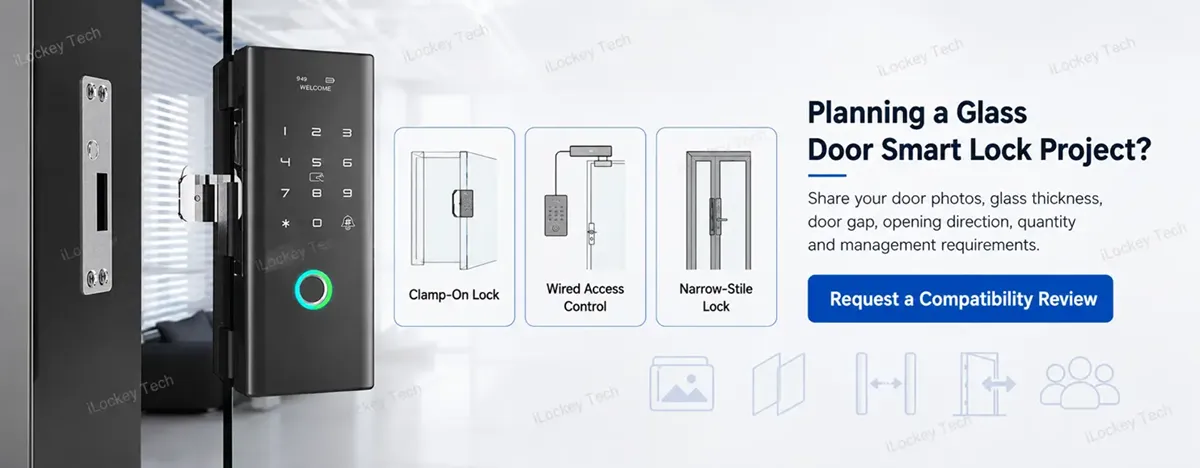
Send front and side door photos, door type, glass thickness, gap measurements at three positions, opening direction, strike location, indoor or exposed environment, project quantity, traffic estimate, credentials, management platform and any integration or compliance requirements.
 11. Conclusion
But the smart lock for glass door is not only the one that has the most opening methods. It’s the one that fits the door, the glass, the gap, the movement, the strike, the traffic, the power, and the management process and local compliance.
A simple 30-second decision rule is useful: choose a clamp-on battery lock for a compatible indoor frameless swing-door retrofit; choose wired access control for a high-traffic or centrally managed entrance; and choose a profile-specific lock for a framed or narrow-stile glass door.
Within that framework, the iLockey G5 is a practical option for compatible indoor frameless glass swing doors that need no-glass-drilling clamp installation, multiple credentials and app-based management. It should be selected on the basis of confirmed G5 dimensions and fittings, not treated as a universal answer for every glass-door project.
For a compatibility review, send iLockey clear door photographs, glass thickness, top/middle/bottom gap measurements, opening direction, single- or double-door configuration, strike location, project quantity, traffic level, required credentials and preferred management platform. A representative-door pilot is the safest way to convert a product selection into a reliable project solution.